Showing posts with label educators. Show all posts

Saturday, October 12, 2013

How Much we Reach and Inspire Educators


I could be here mentioning the educators who have been inspiring me for the past decade, but it wouldn't be fair, as I might forget a name or an episode that transformed me...What I want to say is that since my first trip to a TESOL International Conference in San Antonio, Texas, in 2005, my professional life turned upside down through the many connections I made and the learning I had, picking up the brains from so many inspiring people around the globe. The kickstart, a group of International educators who are constantly connected through a Yahoogroups, called the Webheads. Of course, it goes way beyond the Yahoogroups. We are connected emotionally, we meet each other in conferences, we do collaborative projects together, we share our accomplishments and epic failures. In fact, we rely on the network to grow, to learn, to make sense...

The same way I feel about the Webheads, others experience this feeling of having discovered a whole new world, and what I do for the network is totally worth it when I hear someone say how I helped him/her move to the next level. We never know what are reach are with the ones surrounding us, our kids, our friends, students, teachers. We just know that through connections we are transformed.

So, it was with surprise and enjoyment that I read those words from Márcia, a dear friend, whom I saw grow and flourish in the digital arena,

"Carla is, as I call her, my PLN first love. It was a Sunday, 14 November, 2010, when my life started to change. And it was all Carla's "fault"! I came across Carla’s blog post on elearning speedgeeking and that led me to her twitter account (or was it the other way around?) The truth is, it was then that I fell in love with Carla, who was the first member of my adorable PLN and to whom I owe having become a more engaged and techy teacher. Like me, hundreds or, most problably, thousands of teachers worldwide have been inspired by this passionate dedicated professional, who found the power of technology as a connective and transformative tool in the classroom from her first days as a teacher. Nowadays, more than tech in class, she’s excited about the new possibilities of its way beyond the four walls. That's why for the past years she has, among other things, been an enthusiast Webhead and dedicated herself to the eLearning program at a Binational Center in Brazil, where she is the Educational Technology Supervisor, and to the TESOL EVO Coordinating Team."

I was touched by Márcia's word. I'd never have known that if it weren't for her written words and the EdInspire nomination she made. He words made me realize that, yes, we can make a difference in so many ways. So, let's do what we are meant to do to others. Let's be generous with our communities. Let's do our share. Let's change, let's make a revolution.

And, most of all, let's show appreciation to the ones who inspire us. I'm sure it will mean a lot to them, as it meant a lot to me what Márcia said.

Thanks, Márcia, for your kindness and generosity with me and with our network.

Tuesday, September 3, 2013

Making Homework Assignments Smarter for your Students and their Brains


One of my favorite bloggers, Annie Murphie Paul, has written a post about homework that every educator should consider as a guideline for better learning opportunities. Her claim, based on Neuroscience and Psychology research, entails making better use of strategies that are effectively proven to have an impact on learning.

Annie mentions three strategies that could be used by educators when they are considering the kind of extra-class activities they will assign:

- Spaced Repetition - instead of assigning units of content and then "getting over" them and moving to the next topic, make sure you come back to the content students have explored last week or in the past month over and over in different ways.

As the blogger puts it,
"Exposing ourselves to information repeatedly over time fixes it more permanently in our minds, by strengthening the representation of the information that is embedded in our neural networks."

- Retrieval Practice - In the beginning of the year, I explored the topic in a post about "learning by retrieval", which evokes the power of using testing/assessment tools more often to constantly retrieve information in a more active processing of the brain, instead of just studying content or taking notes. By working on the output of the language, learners are able to strengthen the brain connections for the content they are learning. This requires more of a study-test-study-test-study-test perspective rather than just study-study-study-test approach that we generally have. And by testing, we're not talking just about standardized tests, but self-assessments, quizzes, every kind of assessment that challenges the mind and retrieves information over and over again.

- Interleaving - Consider our homework assignments. Make an auditing of what you've asked your students to do in the past month. I bet that we have generally asked them to focus on the content they're studying right now in class and with types of problems and situations that are similar to each other to "make sense" for the students. In fact, what Annie Paul suggests based on recent studies and even sports training is that we mix up the types of problems and situations students will have to deal with for homework in a way that the sequence is not really predictable. By doing that, we force the brain to "work harder" to try to figure out the solution.

I think that the best chance we have to reconsider our homework practices is to audit what we've been doing and strategically plan ahead. Here's an initial list that might help:

- Have I used any of those three strategies - spaces repetition, retrieval practice, interleaving - in any of my past month assignments? If so, how?
- Have I varied the types of homework I assign to students or do they all follow a regular pattern?
- How challenging and motivating those homework assignments seem to be to my students? Have I ever asked them which types do they prefer, which are more challenging and which they feel are more effective for them in retrieving what they've learned?

Thinking strategically:

- How can I make homework assignments a more meaningful part of my teaching?
- How can I intertwine those 3 strategies to compare learning results?
- How can I check the effectiveness of the new strategies I try to use?
- How can I make homework a more challenging and engaging part of my classes?

I'd love to hear your views and findings about homework in the classroom and how they can be transformed to make it a relevant learning tool for our students.

Monday, September 2, 2013

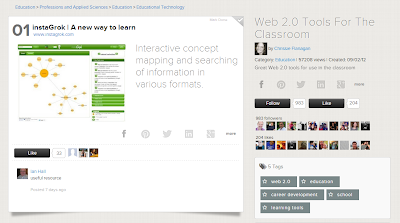
On the Ed Tech Radar - A Learnist Web2.0 Resource for Educators


I´ve already mentioned Learnist as an interesting learning playlist tool that can be used by educators and learners.

This Learnist is one educators will love, with all kinds of digital resources in one single place.

http://learni.st/users/bryanNchrissie/boards/4090-web-2-0-tools-for-the-classroom


Saturday, August 31, 2013

The Magic of Professional Development Claims for a Growth Mindset


For years I've been training teachers and coaching them to integrate technology into the classroom.
The changes I've seen around throughout those years vary from none to new, reinvigorated professionals. How does the move happen?

Change will take many different shapes, from reframing an activity the teacher has already tried out to taking the leap into the unknown and thinking of the transformative power of new technologies in the classroom.

The pace is also varied. Some just jump in, others need a "marinading" period to let things sink in and  make sense of what's going on.


However, transformation has its commonalities from what I've noticed. Educators who embrace change:

- are optimists by heart (even when they seem wary of new situations, deep down there they believe change can be good)
- believe in their own power to change direction, even if they feel insecure at first
- are not considering if the professional development opportunities are paid hours or not (though we shouldn't be working for free, educators with an innovator mindset know that these hours will be paid back in other forms in the future)
- do not count their efforts in time spent, but how their effort transformed their practices
- do not give the same old excuse of lack of time; even in some minutes they can learn something new and apply to their classes
- like the adrenaline rush that comes with new findings
- still believe in the transformative power of education
- enjoy being in class with their students
- have, above all, a growth mindset.

And here's a passage from HBR Blog Network that gives a quick overview of a growth mindset as opposed to a fixed one:

"In her 2006 book, Mindset: The New Psychology of Success, Stanford Professor Carol Dweck distinguishes two extremes of the mindsets people tend to have about their basic qualities:
  • In a fixed mindset, "your qualities are carved in stone." Whatever skills, talents, and capabilities you have are predetermined and finite. Whatever you lack, you will continue to lack. This fixed mindset applies not just to your own qualities, but to the qualities of others.
  • In a growth mindset, "your basic qualities are things you can cultivate through your efforts...everyone can change and grow through application and experience." Qualities like intelligence are a starting point, but success comes as a result of effort, learning, and persistence."

There's certainly no formula to change and I might be a little too simplistic about what I see happening to the educators who take a leap of faith and move on, but in all these years the main traits I see in the ones who transform their classes and themselves are those of optimism, passion, eagerness to learn and attunement to their learners' worlds.

Do you fit in this category of educator who embrace professional development and change as part of your job? Or is it time to rethink what you are doing and how you face things?


If you are interested in the topic of change, you might enjoy reading Becky Bair's post "Changing Our ‘Stuff’ Is Not Enough"

Monday, May 13, 2013

Being an Educator of the 21st Century

Much have been told about the competencies and skills educators should develop to "survive" and thrive in a classroom nowadays. High on my list are some that should have always been there:

>> developing listening skills
>> practicing our empathy at all times, even when we feel like giving up
>> preparing lessons that are brain-friendly, helping our students emerge as engaged learners

To complement my list, I've come across this wonderful chart from an edudemic post:

Is there any other skill you think educators should work on to become full-fledged professionals in our times?


Wednesday, January 9, 2013

Educators as Designers

I've always had a deep fascination for what was aesthetically beautiful for the eyes and pleasing for the mind. Design has always mattered for me, and it has guided me personally and professionally as a principle of good living an a people connector. I've always believed in its engagement power. And unconsciously I understood that through design, you could express to a group a sense of belonging, being part of a community with shared values.

I remember that from the start of my role as an Ed Tech Supervisor how I'd worry about the simple things, starting from a well-design poster inviting teachers for professional development opportunity. I felt that through design, I could show in a way that I cared for them and that I valued their presence in our training sessions. It was not just a simple announcement on the wall, but a call for action, for meaning and connections, and all of that had to be transmitted visually.

When I think of design, though, it is not only about its aesthetics aspects. Instructional design has permeated my role as an educator. Again, when we are aware of the power of certain rules of good practices and processes, learning sticks, the experience of constructing new knowledge holds meaning, engagement, excitement. It takes the learner to the next level, where he/she feels the thrill of experiencing that urge to move forward, to keep learning.

It is also through instructional design that an educator builds community, makes a tribe thrive as a group, considers effective instruction for differentiated learning. If

If, when we make our lesson plans, we start seeing ourselves less of teachers, but more as designers of experiences through creation and exploration with our learners, then we transform the way we teach and learn. We will then realize:

- the meaning of flow from one activity to the other;
- the need for blank spaces to leave room for creation, questioning, experimenting,; and not cramming one activity after another with no space for thinking or wondering:
- the power of a carefully planned lesson with a variety of activities that engage and not bore, but letting serendipity and surprise have their role in the learning process;
- the significance of considering your audience and its specificities to design experiences that make sense and bring on board layers of knowledge construction that are solid, meaningful, and long-lasting.

When we think os ourselves as Designers of learning experiences, we are enhancing the art of possibility and wonder. We become the catalysts of the so-desired change in our classroom microcosmos.

Monday, October 1, 2012

Roaming Mode & Productivity Tools for Busy Educators

Educators are are always on the move. In many different ways.

In class, and according to methodology and findings in the neuroscientific field, we should move around to connect to our learners and assess their activity during the tasks.  We ask our students to do the same, moving, standing up, connecting to peers for the sake of keeping them attentive and interactive.

Many English teachers have more than one job, so they need to constantly commute to go from one class to the other, sometimes even going from one part of the city to the other extreme. Even when educators are full-time in an institution, they have to move from one class to the other, one break time to the next. Circulating is part of an educator´s daily job. An itinerant life at its best.

Peseux calibre 320 movement Not to mention our roaming mode trying to juggle the intensity of school work and our personal lives. There´s no need to say that the golden asset for an educator is time. The currency that we always lack and long for more. As there´s no magic trick to extend the number of hours we have in a day, the only viable solution is to find ways to enhance our productivity and efficiency. Educators need to realize they should be managers of their own time, and good ones!

If somebody asked me the toolkit that could optimize an educator´s urgency for better manage his life, I´d start by exploring four! Four seems to be a manageable number for exploration.
An educator´s toolkit should be composed of tools that are cross-platform (working in different devices & operational systems), so here´s where to get started:


EVERNOTE - Your virtual notebook. You create your notes, to-do lists, lesson plans and aggregate them in one single place. Once you download the app to your cellphone, desktop computer, laptop, and you create an account in Evernote, all your notes are automatically synchronized, which means that important moments, documents, ideas, and visuals are kept portable. Wherever you go, you can access them. Evernote is a powerful tool to organize your main resources, be it professional or personal, and easily retrieve them.
Check the Epic Experiment the Nerdy Teacher is doing with his students using Evernote: http://www.thenerdyteacher.com/2012/07/epic-evernote-experiment-edchat.html


DROPBOX - Your virtual flashdrive. Dropbox, just like Evernote, works in the cloud, synchronizing all the files you add to it with all your devices (cellphones, laptops, desktops). When I want to open any file in my iPad, for example, I just add it to my dropbox and open it in my iPad, using the Dropbox app. It stores all my main files and you can share folders and files with whomever you want, including your students and family members! You can share files and folders.
Here´s an example of some questions I used in class with my students: https://www.dropbox.com/s/6oy4ssy65mkf7iq/Indirect%20questions.doc


FLIPBOARD - Your virtual newsstand. My favorite app ever! It works on cellphones and tablets. What makes it a very special tool is that in one single place, you can aggregate all your social media (Instagram, Facebook, Twitter, Google Reader...), and you can subscribe to specific news feeds, specialized sites, interesting magazines to follow the latest updates. On top of it, the user experience is simply amazing. Though it can add to your productivity and keep you updated on the latest news, you can lose yourself in so many interesting, serendipitous resources that can be a drain to your lack of time. The good thing is that you can always save an article to read it later or email it to yourself and share it with friends and students.


PINTEREST - Your virtual visually-enhanced bookmark. Organize your boards by topic, start following people, grow your personal networks and let the platform and the people behind it filter relevant information for you. You can "repin" relevant resources to your own boards, you can pin interesting links and digital treasures as you browse the Net.
Here are my Pinterest boards for you to have an idea of how it works: http://pinterest.com/carlaarena/


An educator´s life is always in shifting mode, but with the mobile possibilities we have in our hands, we can better manage our routine on the go and add a more enterprising and enthusiastic feel to the many daily tasks we carry out.

I know, I know... The question is always, "From where do I start?"
First, stop lamenting the time you don´t have! Start by signing up for an account in those platforms, click and touch fearlessly, watch youtube tutorials, ask around or ask me. I´d be more than glad to give you the push you need to be a happier and more productive educator! I´m sure once you dig into your digital exploration, you´ll have a smile on your face to have worked on your own personal and professional survival toolkit.


Cross-posted at http://ctjconnected.blogspot.com.br/2012/10/productivitytools.html


Monday, January 16, 2012

EVO - The Art of Curation and Discovery in Professional Development

Just came across George Siemens's insights
"A curatorial teacher acknowledges the autonomy of learners, yet understands the frustration of exploring unknown territories without a map. A curator is an expert learner. Instead of dispensing knowledge, he creates spaces in which knowledge can be created, explored, and connected. ... A curator balances the freedom of individual learners with the thoughtful interpretation of the subject being explored. While learners are free to explore, they encounter displays, concepts, and artifacts representative of the discipline. Their freedom to explore is unbounded. But when they engage with subject matter, the key concepts of a discipline are transparently reflected through the curatorial actions of the teacher."
(George Siemens, Friday, August 24th, 2007 at 10:31)

It is a perfect definition of how we try to do things in the Electronic Village Online, and it hasn't been different this year. With the Classroom Digital Tools session in full steam with 503 participants, the moderators are simply the enablers of people connection and the pointers to exciting educational content. We are designers and curators of meaningful learning experiences. And this is certainly disorienting at first to participants who join us for the first time. Why? Because they generally expect to have a traditional type of training in which we "teach", they "learn", in which we are the "experts" and they are the "recipients".

IMG_0238Soon they come to realize that by joining the EVO, they enter in a different realm of professional development. We are there together to experience learning in a community. And in a community, there's no one way road. In fact, we have roundabouts, u-turns, all kinds of communicational directions to achieve our main goal for the session, provide participants with the opportunity to learn how to be out there in the wild with more confidence, to click around, to explore, connect, add their own voices and to keep daring. Nobody wants to make a fool of himself in front of 500 other people, mainly when these people are educators. We have our own self-image to preserve. However, once participants realize that YES, it is OK to ask, to write in the wrong area, to comment, to make suggestions, to give and get constructive feedback, the learning possibilities are immediately amplified, and it seems that our professional development gets on a whirlwind of new perspectives and directions with the wonders of new nodes and connections with educators around the globe.

Week 1 in EVO is always daunting, a bit scary at times, but it is also a time of allurement and fascination, a time for discovery and optimism that reenergize us as professionals and educators trying to make a difference in every learner's life and in our own.

I can't help myself, but be totally touched by what has been shared in our session by participants coming from all over the globe with their multicultural perspectives, trying to see what works and what doesn't in their contexts.


Week 2 in the Digital Tools group has started with some creative minds in action! We never know where it is going to take us with such a fantastic community. Let us keep exploring the unbound freedom of guided discovery...

Some highlights of our session also available at http://www.scoop.it/t/classdigitools

Tuesday, November 2, 2010

What does it take to be an Educator nowadays?

This is a question that has been widely discussed. And I'm sure that better than I could be writing or saying, this blog post resonates with my own thoughts on the issue.

However, as I browsed through this wonderful hyperlinked world this morning, I found this:
http://classtools.net/widgets/postIt_9/3KrcD.htm


In the past, I've come across with classtools many resources. Isn't it neat the fact that anybody can just get there and edit it? Lots of possibilities! Ready to share your own idea for a cool use of the classtools site?

Thursday, August 5, 2010

Value your DNA - Keep Passion Alive

I've just started reading a very pleasant book. Nothing new, but simply painfully true. Gary Vaynerchuck's "Crush it" talks about being true to our DNA in the beginning of his book.

For me, being true to our DNA is rescuing our roots and reminding ourselves what really makes it all worth it. I've been talking more and more, or even preaching, about the power of passion in everything we do. I've seen many educators with their passionate instincts dormant, just burnout, stressed out, lifeless...They even forget why they've started. They forget how fiery they once were about teaching, learning, the classroom....


I'd say that we need to start a Rescue your DNA program, in which inspiring people, professionals, educators find inspiration in what they believe in and who they are. What ticks them? How can they match their passions they once had and are latent into vibrant forces that are conducive to self-fulfillment, effective teaching and on-going learning?  What is the balance of keeping up with our routine, but not keep our drives simply inactive. We all need action, movement, transpiration, passion in our lives. We need to be true to our DNA. We need to find understanding and truth in what we do to be multipliers of powerful inspirational sourced to the ones around us. We need to transform or reform ourselves to be agents of change in society.

How should we start regaining passion in what we do and who we are?

Thursday, July 8, 2010

Say NO to Change

Why bother?
Why leave the comfort zone for the unknown?
Why seek emotion and a bit more of fun into our dull lives?
Why should one work harder just for the sake of changing?
Why even consider the transformation if all things seem to fall into place?
Why innovate if someone else will get the credit?
Why do something different if everything seems to work the way it is now?
Why alter the state of our classrooms if the students are learning for centuries this way, but just seem "a bit bored"?
Why transition to a more proactive view of professional development if I won't get a raise?
Why spend my precious time studying, searching, planning for better teaching if I won't get more recognition from my superiors?
Why the shift?
Why the move?

That's why most of us keep saying NO to the inevitable passages in life, when we have to transition from our well-known, safe routine to a new "unpredictable" mode of thought and act. Though we might question ourselves the WHY, and this is healthy when it doesn't block the possibilities ahead, innovating, moving towards a new direction, finding a more appropriate perspective to learning and teaching is simply part of our own evolution as human beings, as educators.

sayYES

The word CHANGE is part of my daily job. Every day, there's something new that makes me change the way I see things, a new tool to do things more efficiently. Though resistant at times, I've learned to listen to opposite views, to ponder, and to come to the conclusion when change might be beneficial to the collective.

Say YES.
Innovate.
Surprise.
Give a new sense to your own life.
Bring life to your classroom.
Make it lively.
Laugh, dance with your students, sing a song, create one.
Let breadth and new light enligthen your educational practices.
Learn with your students.
Don't expect recognition, except your own perception of how engaged, motivated your students are.
Consider your own small rewards when you see a sparkling eye, a curious soul.
Laugh again.
Teach with passion. Teach with soul and intuition. Find magic in the small details.
Add bits of tech before you can call yourself a true innovator.
Keep daring.

Are you still considering saying NO to change? Well, you might use 100 lame excuses to avoid becoming a more adventurous, happier educator. Or you might start considering making small innovative changes that will make a difference in your and your learners' lives pretty soon.

Say YES to your very simple changing acts.
Try it.
It can be really powerful!
Let's start right now a Say YES movement.

I'd love to hear what you've done to substitute inertia for hard-hitting transformation.

Thursday, February 18, 2010

Join #edchats

There are many educators and people in general who think Twitter is just for nonsense personal types of things. However, I must say that since 2007, it has provided me with insights, connections, resources that go much beyond "in the bathroom", "at the airport", "at home" types of prepositional tweets.

If you start following the right tribe of your interest, magic is likely to occur. I'd say, professional magic. If you don't know where to start, a while ago, I invested some time to create a page with the basics of Twitter for educators that might give you a boost in this microcosmus of possibilities. Access http://twittering.wikispaces.com/

Well, all that to invite you to join twitter conversations using the hashtag #edchat. Though Twitter is meant to be an asynchronous tool, there's always a nice twist people imagine, mainly educators! A group of educators decided for a specific date and time for these educational discussions in Twitter, and now it became a live feast. For all the details on what a hashtag is, how it works, and how you can participate in the Tuesdays #edchats, take a look at: http://teacherbootcamp.edublogs.org/2009/08/18/edchat-join-the-conversation/

Your tweetlife will never be the same...

Thursday, October 8, 2009

Rewarding Networks

Yesterday was delightfully exciting. Never have I worked so hard and intensively in different projects for the school I work for and my volunteer work in the communities I'm part of . No complaints. All the effort has been paying off. First, I got to know that our proposal to present in the TESOL international conference. More than being happy that our proposal had been accepted, we were thrilled to know that we will be able to share a bit of what we been doing in terms of language online learning. In fact, we don't want to show what WE are doing, but what our learners are producing, their content, their making sense of the world and the language.
http://listeningplus.pbworks.com/1o2008
http://www.pageflakes.com/edutechtools/24766454

Another highlight of the day was the e-tutoring online training session we are facilitating for the state of São Paulo educators. What an interesting, diverse group that emanates energy and curiosity about the digital possibilities they see ahead. It's a challenging mission because for most of these educators elearning is a totally new experience. However, I can see that they are into this new stage of their professional development. Uplifting.


Visit Online Start


Last but not least, as I was interacting with the participants of the training session late at night, I got to know first hand on twitter that I had won a nice blogging competition proposed by the inspiring Sue Waters. It was a simple task and one that everyone could contribute to create a mosaic of useful blogging tips.

All in all, the lesson of the day was that the best reward is being part of a network, a hyperlinked network of people who share, dare and help put together the pieces of our digital educational world. Thrilling.

Friday, December 12, 2008

Flickr Educational Power

As a group of wonderful, inspired educators - Alice Barr, Ana Maria Menezes, Bob Sprankle, Cheryl Oakes, Daniela Munca, Jane Petring, João Alves, Mary Hillis, Nina Liyulkun, Ronaldo Júnior, and Susan Burg - get ready to co-moderate a free six-week online session, Images4Education, through the Electronic Village Online, I've been totally immersed in Flickrverse. My main focus has been the potential of Flickr in the Classroom.

It's been a journey of discoveries. True pearls. Starting with Mike Coghlan's tweet and enjoying his very straightforward wiki which he's been using to train educators.

mikes_tweet

I'm lucky to be in Twitter and connect so easily to others...

Back to Flickr, would you like to see even more? The wiki http://educationalsoftware.wikispaces.com/Flickr is a very comprehensive resource if you plan to work with Flickr4Education.

By the way, a Diigo group called Flickr in Education was also a place that I looked for good references. Though it is still a small library of bookmarks, it has provided me with great tools and blog posts. Our own Diigo space to share bookmarks during the Images4Education session is starting to take shape and soon will be a resources-rich hub for educators when the group starts to add their contribution.

Talking about Flickr posts that are worth exploring and considering in an educational setting, here are some true gems worth spending time with, even if they are not all directly connected to education, they can give you wonderful ideas:

My Own Interesting Snippets

Why Flickr and Alan Levine Rock
Telling Tales with Flickr
Classroom Uses of Flickr

The Davey's: Best of Flickr
Embed Flickr Notes in Other Websites

Motivating Language Learners with Flickr

These are just some of the finest pearls I've bumped into recently, or have bookmarked them some time ago.

By the way, an idea that comes to my mind. What if we all bookmarked in Diigo Flickr resources we found in cyberspace related to education, Flickr4Education? Not only that, what if we tagged Flickr4Education our Flickr photos that might be of interest to the educators community? What if we started the #flickr4education in Twitter? I'm sure Flickr would be even more powerful for our community with a collective action to bring together loose pearls out there in cyberworld into consistent tagging.

Let's start right now the flickr4education movement and show the educational power of Flickr.

Tag it: flickr4education