Showing posts with label TEFL. Show all posts

Monday, September 9, 2013

On the mLearning Radar - Creating on iPads


I´ve just come across this box of mlearning treasures that an art teacher/teacher trainer has put together. Though the focus is on digital art, many ideas can be adapted for the language classroom.

http://drydenart.weebly.com/creating-on-ipads.html
Mrs. Fuglestad has also created a Smore page with ideas for ipad creation. What I think could be the main focus for language teachers is to consider the mobile devices students have to work on language production and creation, just like in an art class.

https://www.smore.com/r98j-summer-ipad-lesson-ideas


Can you think of any idea to remix an idea Mrs. Fuglestad presented to fit a lesson plan you will be teaching in the near future?


Thursday, September 5, 2013

Teaching a Dramatically Outstanding Class - Tension and Release


Yesterday I was talking to a very experienced teacher who I know suffers from the same syndrome I do and most of the teachers out there do. The how-can-I-reach-teens syndrome.

We all develop strategies, sometimes war strategies, we think and re-think ways that we could better engage our teens. The roller coaster is always on and the list of our trials and errors abounds:

- using tech in class
- making them move
- using topics that are close to their hearts
- songs
- giving some free time if they "behave"
- using games

And the list goes on. Some activities seem to work better than others. And my guess is that generally what ticks our teens are not exactly those sophisticated types of lessons that we spent hours preparing. Sometimes they surprise us by enjoying a very simple task you propose. Have you every considered the main elements of these moments of engagement are made of?


2010 Teen Arts Fusion | Graphic Novels

My insight tells me that no matter what we do, what makes an activity engaging is not the degree of sophistication or the main topics that will reach our learners or even the many hours you took to prepare it. Just today I read an interesting article that gave me a hint of what might make a class dramatically outstanding in which you feel that sense of flow and you know the students are there with you in the same wavelength. As stated in Wikipedia, you and your students turn into
"mental state of operation in which a person performing an activity is fully immersed in a feeling of energized focus, full involvement, and enjoyment in the process of the activity. In essence, flow is characterized by complete absorption in what one does."
How?

By unconsciously using the idea of "Tension and Release", by creating a moment in which you reach a climax of your class with an activity that the students feel compelled to participate, to "solve the puzzle", to be part of it. That's why storytelling is so powerful. It is just one of the many shapes you can build upon the idea of "tension and release" to create engagement.

Let's consider, for example, TV shows, series, Brazilian soap operas, films...What do they do to keep us there on the edge of our seats?! Tension and release! That moment before the disclosure where our heads spin, then the relief of seeing everything unfolding.

When was the last time you had this "tension and release" moment in your class? What made it special? What was your trick?

If we teachers can spot these aha "tension and release" moments in our classes, our how-can-I-reach-teens syndrome might be overcome.

Tuesday, September 3, 2013

Making Homework Assignments Smarter for your Students and their Brains


One of my favorite bloggers, Annie Murphie Paul, has written a post about homework that every educator should consider as a guideline for better learning opportunities. Her claim, based on Neuroscience and Psychology research, entails making better use of strategies that are effectively proven to have an impact on learning.

Annie mentions three strategies that could be used by educators when they are considering the kind of extra-class activities they will assign:

- Spaced Repetition - instead of assigning units of content and then "getting over" them and moving to the next topic, make sure you come back to the content students have explored last week or in the past month over and over in different ways.

As the blogger puts it,
"Exposing ourselves to information repeatedly over time fixes it more permanently in our minds, by strengthening the representation of the information that is embedded in our neural networks."

- Retrieval Practice - In the beginning of the year, I explored the topic in a post about "learning by retrieval", which evokes the power of using testing/assessment tools more often to constantly retrieve information in a more active processing of the brain, instead of just studying content or taking notes. By working on the output of the language, learners are able to strengthen the brain connections for the content they are learning. This requires more of a study-test-study-test-study-test perspective rather than just study-study-study-test approach that we generally have. And by testing, we're not talking just about standardized tests, but self-assessments, quizzes, every kind of assessment that challenges the mind and retrieves information over and over again.

- Interleaving - Consider our homework assignments. Make an auditing of what you've asked your students to do in the past month. I bet that we have generally asked them to focus on the content they're studying right now in class and with types of problems and situations that are similar to each other to "make sense" for the students. In fact, what Annie Paul suggests based on recent studies and even sports training is that we mix up the types of problems and situations students will have to deal with for homework in a way that the sequence is not really predictable. By doing that, we force the brain to "work harder" to try to figure out the solution.

I think that the best chance we have to reconsider our homework practices is to audit what we've been doing and strategically plan ahead. Here's an initial list that might help:

- Have I used any of those three strategies - spaces repetition, retrieval practice, interleaving - in any of my past month assignments? If so, how?
- Have I varied the types of homework I assign to students or do they all follow a regular pattern?
- How challenging and motivating those homework assignments seem to be to my students? Have I ever asked them which types do they prefer, which are more challenging and which they feel are more effective for them in retrieving what they've learned?

Thinking strategically:

- How can I make homework assignments a more meaningful part of my teaching?
- How can I intertwine those 3 strategies to compare learning results?
- How can I check the effectiveness of the new strategies I try to use?
- How can I make homework a more challenging and engaging part of my classes?

I'd love to hear your views and findings about homework in the classroom and how they can be transformed to make it a relevant learning tool for our students.

Monday, September 2, 2013

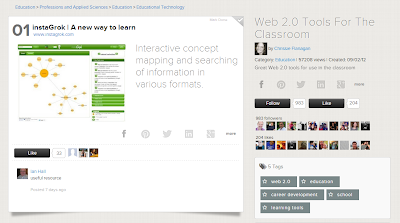
On the Ed Tech Radar - A Learnist Web2.0 Resource for Educators


I´ve already mentioned Learnist as an interesting learning playlist tool that can be used by educators and learners.

This Learnist is one educators will love, with all kinds of digital resources in one single place.

http://learni.st/users/bryanNchrissie/boards/4090-web-2-0-tools-for-the-classroom


Sunday, August 11, 2013

Introductions Practice in the EFL Classroom with Authentic Content


Besides using Haiku Deck app to create visually-appealing presentations, what if you used it with students to help them use language with content produced by real people. So, it is the old "this is..; she does this and that" with a twist in authenticity.

Take, for example, this presentation:


Created with Haiku Deck, the free presentation app for iPad


  • The teacher could ask students to present her in the form of a paragraph with the most important information. 
  • Students can prepare questions based on the information presented, and then another students would act out as if she were the lady. 
  • Students could work on expanding the information on a slide as if they were the woman, i.e., they could talk about her 3 sons and husband (slide 2)

I'm sure you'll find wonderful "about me" presentations to work with language authentically in Haiku Deck's Pinterest Board:


Of course, it would be great if students could use one of the sample presentations to prepare their own "about me" page. 


Friday, July 26, 2013

TEFL Conference Series Part 1 - App Swap


The app swap we had in IATEFL 2013 in Liverpool with Joe Dale, Shaun Wilden, Ana Maria Menezes, among other educators make me consider repeating the model in our CTJ, Alumni and IBEU TEFL Conference in Brasilia.

The session in which participants were the lead presenters in break out groups were the stars of the session, sharing with others their favorite apps for the classroom or for personal use. Vinicius Lemos and I started by giving an example of tools and, from there, teachers never stopped sharing.

As they shared their favorite apps with the others, we kept walking around adding the names of the apps to our collaborative page on Todaysmeet.

Enjoy it. Try some them.

http://todaysmeet.com/appswapctj


You might be interested in the shared list of apps in IATEFL at http://list.ly/list/4NE-app-swap-iatefl-2013

Saturday, June 15, 2013

Images in the Classroom - Now and Then


I've always had this natural inclination to add images to whatever lesson I was teaching, and now even more so when I see the neuroscientific reason for doing it. James Zull, in his book "the Art of Changing the Brain", mentions that
"Our concrete experience contains much of the information we need for understanding, because it produces images for our brains to analyze, rearrange, manipulate, and turn into action. We have maps of our experience in our brains, and we can run through these maps like the frames of a moving picture."

He goes on to say that the images in our brains come from the experience itself and that's why
"teachers could make extensive use of images to help people learn. If we can convert an idea into an image, we should do so. And whenever possible, we should require our students to show us their images. It should go both ways"
Having the power of images in mind, our classroom should be visual-rich and empowering. It should help our learners enhance their language skills through their sensory brains. In this sense, today I just came across a Facebook post by Ben Goldstein where he mentioned a blog called Dear Photograph  in which the audience shares images of a past original setting and taking a photo holding a film photo of people in the same place.

http://dearphotograph.com/image/52871635425 

Now, imagine having the same kind of project with your group of students after they've explored some of the images in the Dear Photograph blog. You can ask them to talk to their parents and relatives, to find nice photos of places that they could go and take the same kind of picture, holding the film-developed photo. Plus, you can explore the use of the past in the images contrasted with the present. The teacher would have the perfect timing to talk about "USED TO", for example, and then use students' own images to explore language in a totally contextualized way.

Then, in the same Facebook thread, Paul Driver suggested the use of the Zefrank's blog project Young Me/Now Me for the same kind of activity in which students take their own photos, explore the blog's photos and use language to compare and talk about the differences between now and then.

http://www.zefrank.com/youngmenowme/permalink.html?469

Thanks to Ben Goldstein and Paul Driver in my FB network for the visual inspiration!

Wednesday, May 15, 2013

Do Something for Teens


Do Something is a non-profit organization in the intersection of teens and social change, activism.

There are tons of ideas on their site to help young people take action. I especially liked one about what makes you mad and the call for changing things around.
http://www.dosomething.org/actnow/actionguide/become-activist 

As I have a tight schedule, I was considering adapting the idea to something simpler:


>> Groups decide what make them really mad
>> They make a fact sheet with 8 facts about their issue, starting with, "Did you know that...?"
>> They create a motto about the situation
>> Students then write a manifesto about their topic to raise awareness and finishes the manifesto with the life motto they've created.
>> Taking a step further, we could vote for the best group motto and then create posters and even print T-shirts with the motto on it.

Simple and sweet. I guess this would be a great opportunity to talk about community issues, have students as agents of awareness & change, all that being done in English. What do teachers think?

Tuesday, May 14, 2013

A Teen Educator Failing Miserably


For some, I might seem confident and a bit tech-savvy.
However, with teens it seems that I'm bond to failure. That's how I feel so often. Teaching them is like a roller coaster. Yes, don't get me wrong! Sometimes I fear I won't reach them. Every time I prepare my classes I have the feeling that I'm about to fail miserably. It is like that first part of the ride in the roller coaster when you really don't know what's next and your stomach swirls.

Roller Coaster My classes are always a box of surprise. Teens never stop to amaze me when I get to that adrenaline part of the ride - being in the classroom. They are always surprising me with their wittiness, creativity, eagerness to do something different. What I've come to realize in my ride is that every time I take for granted what they like, what moves them, what ticks them, that's when I fail. There's no way out. I use the book, but I can't just follow as it is. Why? The topics are totally apart from my teens' dreams, reality, daily lives. So, just like they have to adapt to me, to my own teaching style, I must be open to adapt to them, right?

Last class, for example, I wanted to give an example on the board and invited them to give a name of a famous person. Oh my! I could see the sparkle in their eyes talking about Megan Fox and Ian-I-Don't-know-who! They wanted to show me photos, they wanted to know if I thought they were cute. And when I said they were not my style. They wanted to know who I liked. Well, "besides my husband??? Andy Garcia!" . "Andy, who, teacher?!" "Oh never mind..." This is exactly the bridge we need to cross to enjoy the ride until our next failure or until our next adrenaline rush.

So, how do you feel about teaching teens?

Monday, April 22, 2013

IATEFL Conference 2013 Ed Tech Highlights


IATEFL was just some days ago, but things get so hectic when we get back that it seems that it was so long ago... The highlights of an international conference like IATEFL is always related to the people you meet and talk to and the networking that takes place everywhere, on the streets, on Twitter, in the Convention Center corridors, during break time. It's always time to connect, talk, discover, experience.

If you ask me about specific things I've paid attention to and took notes, here are they in my Notes:

Learning Technologies Pre-Conference Notes

Notes Day 1

Notes Day 2

Notes Day 3 and 4


Also, there were some amazing bloggers who would post the summaries of the presentations almost real time.

Graham Stanley's summaries mainly related to Learning Technologies.

Chia Suan Chong's summaries


And the grand finale with our wonderful App Swap. In the corridors of the Convention Center, we exchanged fun and serious apps for personal use and for the classroom. Ana Maria Menezes did a wonderful job compiling all of them!

Amazing days of learning and connections.

Sunday, March 31, 2013

Filtering Relevant Information for the EFL Classroom through Digital Curation


This is the time of the year that I get totally thrilled. Convention time. IATEFL, Liverpool. Promising. My second time in one of the best EFL teaching conferences in the world with wonderful professionals willing to share best practices, research, classroom ideas that can really make a difference in our classrooms.


I'm pleased to be presenting about a topic that has been dear to my heart for the past years, and now I've been exploring its many facets more in depth, Content Curation. Though I've presented it twice, I've revamped it a bit, not its essence but some interesting tools I've been using lately. So, if you are around Liverpool, why not joining us for a chat about how to make sense of this world where information more than abounds?

   Any curatorial tools that you've been using lately that you think have made a difference in your efficiency and productivity as an educator? I'd love to hear about it.

My latest experiments have been with http://newsmix.me/carlaarena . Still finding my way around, but enjoying playing around with it.

Here is some background on digital curation that you might find useful:


Here's Graham Stanley's summary of the presentation: Graham's summary

Friday, March 29, 2013

mLearning - Evernote as a Trigger for Writing


In the Binational Center I work for writing is taken seriously. There is a program for all levels. For the Teens and Intermediate courses, students work on paragraphs, but when they get to the Advanced level, the requirement is more demanding. Learners are exposed to different kinds of genres and are supposed to hand in a fully-developed composition. A dreading activity for many.

This semester, I have a group of very young teens who are Advanced students, so this was an extra challenge, as they are still very raw in terms of writing skills and styles, but I am an optimist by heart and always believe that depending on the way you develop the activity results are unexpected, but impressive.

I decided to try Evernote as a writing portfolio and it has proven to be an effective move towards engagement. The writing task was for students to choose a story in their lives and write about it. As a pre-writing activity, we told each other some funny, sad, embarrassing stories to each other. Then, instead of projecting the PPT slides to go through the idea of how to structure the stories, this time still paragraphs, I had previously downloaded in each iPad the PPT to Keynote so that students had more control over their activity. They worked in pairs, exploring the concepts of topic sentence, adding details and concluding ideas. We went over some stories in the Keynote app together and discussed how effective the introducing sentence was, how we could make it better, if the reader would be interested in keeping reading with that introduction, etc.


In the second stage of the activity, I asked them to open Evernote, add their names in the title of the note and they had a chance to write their stories in class. They used the Longman dictionary app in the iPad and were totally into their writing. As we work with process writing, I, then, could open everybody's work on a single notebook (the ipads are all synchronized with the same Evernote account) and printed the paragraphs to correct them using the proofreading symbols. In the following class, a question surprised me, "teacher, do you have our paragraphs?" Never have I had my teens students so interested in their pieces of writing. Again, I handed out the iPads and before I realized it, they were reading each other's texts! I gave them the printed version of the first draft with my comments and the symbols for them to figure out what was wrong or missing, so a focus on the structure, but with my comments focused on the content. They grabbed the iPads and worked on the second version of their paragraphs. I could give individual assistance to all and also encouraged peer correction for the faster ones. They helped the ones who had more difficulty to develop their ideas.

The results? On one single Evernote note, I had students' first and final drafts. I could easily visualize their progress with not much fuss. They were totally engaged in the activity and could easily play around to edit their texts. It didn't even seem to be the dreaded writing assignment that had been for so many years haunting English learners. And in the next writing activity, they can easily refer back to their notes, which I can share via email or link with them. I really feel that just the fact that you are using their means has made a difference in their reaction and attitude towards writing. Besides that, their reading audience was amplified. Classmates read their pieces, and even other Advanced groups who were also writing their stories in another Evernote notebook.

Here are same samples of students' writing (published with their permission):

1st Draft
I'll never forget the day my brother got stuck inside a suitcase. Me and my family were still living in the United States when this happened, it was a very cold day so me and my brothers were stuck at home  bored out of our minds with nothing to do but watch tv. After a while my mom called us all, including my dad , and said that her boss and his wife were coming by for a visit. When they arrived they were caring a giant suitcase ( don't ask me why because I don't remember) anyway they sat down in the living room and my parents began talking to them. My brother,who was seven at the time, had the briliant idea of going inside the suitcase and shutting himself in there, okay i'll admit it I helped him. We laughed for a while and then he said he wanted to get out , I began pulling on the zipper to open the bag but something was wrong, the zipper was stuck. Well that was all it took as soon as I told him I couldn't open it he began crying and screaming and that caught my parents and our guests attention. In the end my dad had to break the zipper to get him out of there, it seems funny now but back then it was pretty scary, at least for my brother.

2nd draft
I'll never forget the day my brother got stuck inside a suitcase. My family and I were still living in the United States when this incident happened. It was a very cold day so my brothers and I were stuck at home  bored out of our minds with nothing to do but watch TV. After a while,my mom called us all, including my dad, and said that her boss and his wife were coming by for a visit. When they arrived, they were carrying a giant suitcase ( don't ask me why because I don't remember). Anyway, they sat down in the living room and my parents began talking to them. My brother,who was seven at the time, had the brilliant idea of going inside the suitcase and shutting himself in there.Okay i'll admit it, I helped him. We laughed for a while and then he said he wanted to get out.I began pulling on the zipper to open the bag,but something was wrong, the zipper was stuck.Well, as soon as I told him I couldn't open the suitcase he began crying and screaming, which caught my parents and our guests' attention.From that point on I couldn't tell who was panicking the most, my mom or my brother.My father tried opening the bag too, but it was no use that zipper was not going to budge.In the end my dad had to break the zipper to get him out of there.It seems funny now, but back then it was pretty scary, at least for my brother.

1st Draft
I will never forget the day that a hook entered my cuticle. Last vacation, I was having a trip with my brother, my parents and my grandparents. We have gone to Araxá, a small city in Minas Gerais. It is a very cool place. When I arrived there, the first thing I did was wait for my mother to do the check in. There was nothing to do in the city, so I stayed at the hotel, doing some wonderful activities, like riding used bikes every day, swimming, sleeping, watching TV, running, fishing...
The routine was the same every day, but it was relaxing. Until the accident happened: In one of these days I was fishing like how I fished every day, but when I was putting the bait in the hook and a little kid pulled the fishing rod. The hook entered my cuticle, got stuck in there and my finger started bleeding. I went to the hospital in the city and the doctor cut the hook. After some hours, my finger was ok and I came back to the hotel. It was a great adventure, and I enjoyed it (except the part that the hook hurt me).

2nd Draft
I will never forget the day that a hook perforated my cuticle. Last vacation, I was preparing a trip with my brother, my parents and my grandparents. We went to Araxá, a small city in Minas Gerais. It is a very cool place, since there is a very low chance of violence and there are many special places to meet in the hotel, like the Burle Marx garden, or the presidential room. When I arrived there, the first thing I did was wait for my mother to do the check in. There was nothing to do in the city, so I stayed at the hotel, doing some wonderful activities, like riding used bikes every day, swimming, sleeping, watching TV, running, fishing...                                                                                                                             The routine was the same every day, but it was relaxing until the accident happened. In one of those days, I was fishing like I fished every day, and a little kid pulled the fishing rod while I was putting the bait in the hook. The hook perforated my cuticle, got stuck in there and my finger started bleeding. I went to the hospital in the city and the doctor took out the hook. After some hours, my finger was ok and I came back to the hotel. It was a great adventure, and I enjoyed it, except the part that the hook hurt me.


Have you used Evernote as a writing Portfolio? How?


Thursday, March 28, 2013

mLearning - Turn your Ipad into an Interactive Board


Educreations, Showme, Screenchomp are  simple and multifaceted for the language classroom. These free screencasting apps have multiple possibilities, ranging from recording students' dialogues or letting them freely talk about a subject as they show on the screen what they are exploring. There's drawing, typing a text or inserting an image while recording. The students can change colors, sizes, forms in a totally intuitive way.

Besides all these advantages of language production, once it is ready, you can publish them on a website and share your students' work with parents, the students themselves and the world.
Here's an example of what my students produced. They had to create their own stores:


Which one would be interested in visiting?


Which one would you be interested in visiting?
This is just one of the possibilities for these screencasting apps. I like to consider them a platform to enhance students' creativity and free production, but it certainly goes beyond. Here, for example, I used Educreations to create a challenge for my students. We were studying the difference between "Used to" and "would". They had to listen to both stories and check the differences and try to guess which version was the correct one:


How about teachers and students creating tutorials? Easy with these tools, just some touch and clicks away!

By now I think you can really picture how nice these apps can be for the language classroom, but there is one way you can use one iPad to turn it into an interactive board. What you need to do it? Only the iPad and a projector in the classroom! You can just open the app type, draw, show images, move things around  and record what you are saying as you go, and all this can be projected for students. You can add things to the white board, as well as delete them. However, more exciting than that is inviting students to come to the front and teach a lesson, touching things in the app, making them gain life as others interact with the learner. If you wish, you can even share the lesson afterwards with your students by just sending the link to it. Ready to give this idea a try? I'm sure you'll be amazed by its potential, and would love to know the results if you try using these screencasting apps as an interactive board!

Saturday, March 23, 2013

mLearning Activity - Trending Topics and Classroom Bonding


Trending topics, those hot topics of the day or sometimes the hour, are everywhere on social media. They represent what is ruling the world for different tribes.

So here's a very simple activity I've done with my students that has long-lasting, impacting effects in our classroom because of the emotional connections it enhances.

Trending Topics Activity
Students can use their cellphones or tablets note taking app.
Before you start, ask if they know what trending topics are, where you can find them. They will probably mention Twitter.
Then, tell the that they should write about the trending topics in their lives. They can even use the hashtag (#) and key words for their hot topics.
When they are finished, they partner up with another student and find things in common in their trending topics and ask each other more questions to expand on them.

Some Follow-up Suggestions
You can ask your students what they found out about their partners or their trending topics that they didn't know about.
You can write on the board students' trending topics making two columns: one with the ones you know; other with things you've never heard of. Students can, then, teach you about ythe key word you have no idea of.

In my case, I asked the students to email me their trending topics. In the following class, I made a list of common trending topics of the class and we talked about them as a group. I also posted some hashtags that were mentioned only by one student to give me a chance to personalize the activity and learn more about my students' interests.

My Teen Students' #trendingtopics

The fact that I've kept those trending topics mean that I can use them to give meaningful examples to students, look for resources that are suitable to their interests (music, movie clips, sitcoms segments) and, most importantly, connect to them in very personal and meaningful ways. I am closer to their world, they are teaching me things from their world. By doing that, I am making my teen classroom a much more emotionally-friendly environment where we ware not simply learning a language. We are using English to talk about our lives and what rules our world.

Variations of the Trending Topics Activity
Ask students to guess what the trending topics are in Twitter at that moment in different places of the world. Then they check if they got any similar to Twitter and discuss why those hashtags are trending topics.

Another possibility: use the topic that you are studying to build a trending topics wall and transform the into a word cloud, using Wordle, for example.

So, do you know the trending topics in your students' lives? What are your trending topics?


Thursday, March 21, 2013

Taking Learning Into a Visual Experience Through Infographics


Evolving, progressing, developing. Not always an easy task, mainly for very busy English teachers who have heavy schedules, different groups with varied age range and levels of proficiency. But still, they are up to the challenge of after a long day of work to come to a Teacher Development Course to keep improving to become for full-fledged professionals.

That's the context I have with my also challenging job of working with these teachers to raise their level of understanding of Ed Tech issues and help them learn about practical Ed Tech ideas for their classrooms. Challenging not because of the educators I have in class. They are a fantastic, enthusiastic bunch. Daring because of the responsibility of having a full month for Educational Technology in the Methodology part of the TDC program. Until last semester we'd have only a 2-hour encounter with TDC students. So, two hours turned into a fascinating monthly opportunity to inspire, go above and beyond with those teachers.

Of course, it is no easy task for them. Besides the heavy duty of going through many different concepts, ideas and practicalities of integrating Ed Tech in the classroom, they still have to deal with the hybrid format of this part of the course (1 face-to-face class + 1 online class per week) and my pushing them to do more than just average. A bit of pressure, I know, but I'm totally in awe of what I've seen so far, particularly what I had the chance to contemplate, discuss and learn about last class.

I had assigned Mark Warschauer's text "Technological Change and the Future of CALL", part of an ESL & Applied Linguistics Professional Series, "New Perspectives on CALL for Second Language Classrooms", edited by Sandra Fotos and Charles Browne. Besides classroom discussion, I wanted to profit from the elearning environment and the new trends in Ed Tech to explore the possibilities of the use of infographics in the classroom. There was a bit of whining and moaning because of the complexity of the infographics platforms and technical issues that students faced, but the outcomes were simply way more than one could ever expect...
The student-teachers found their own ways to overcome the technical challenges, and the result was a class full of sharing, discussions and considerations about CALL history, its present state and what the future holds. The infographics were the springboard that inspired us all to learn and share. One of the students, a designer by heart and profession, was even applauded by the class when he entered the room with his infographics created in Illustrator that not only visually represented the text but also enticed the readers to consider our pedagogy in the 21st century in his humorous bottom part of the infographic:

by Gustavo Dias

And here's the collective effort of the group that makes me certain that, yes, even with some pain, there was an amazing learning gain that I am super proud of. I hope that these teachers understand the power of such an activity to take their own students to another learning level. Not that they will ask students to create an infographic, but what are some of the creative practices we can adopt to enhance learning in an EFL/ESL classroom and really give choice, purpose and audience to our students' production?

If you are just curious about the infographics platforms that I suggested, here they go:


visually 
easelly
   infogram
    piktochart

Just remember that if you want to try them out, do like my students: persist!

For some cool infographics >>> http://pinterest.com/ctjonline/infographics/

Wednesday, January 9, 2013

Educators as Designers

I've always had a deep fascination for what was aesthetically beautiful for the eyes and pleasing for the mind. Design has always mattered for me, and it has guided me personally and professionally as a principle of good living an a people connector. I've always believed in its engagement power. And unconsciously I understood that through design, you could express to a group a sense of belonging, being part of a community with shared values.

I remember that from the start of my role as an Ed Tech Supervisor how I'd worry about the simple things, starting from a well-design poster inviting teachers for professional development opportunity. I felt that through design, I could show in a way that I cared for them and that I valued their presence in our training sessions. It was not just a simple announcement on the wall, but a call for action, for meaning and connections, and all of that had to be transmitted visually.

When I think of design, though, it is not only about its aesthetics aspects. Instructional design has permeated my role as an educator. Again, when we are aware of the power of certain rules of good practices and processes, learning sticks, the experience of constructing new knowledge holds meaning, engagement, excitement. It takes the learner to the next level, where he/she feels the thrill of experiencing that urge to move forward, to keep learning.

It is also through instructional design that an educator builds community, makes a tribe thrive as a group, considers effective instruction for differentiated learning. If

If, when we make our lesson plans, we start seeing ourselves less of teachers, but more as designers of experiences through creation and exploration with our learners, then we transform the way we teach and learn. We will then realize:

- the meaning of flow from one activity to the other;
- the need for blank spaces to leave room for creation, questioning, experimenting,; and not cramming one activity after another with no space for thinking or wondering:
- the power of a carefully planned lesson with a variety of activities that engage and not bore, but letting serendipity and surprise have their role in the learning process;
- the significance of considering your audience and its specificities to design experiences that make sense and bring on board layers of knowledge construction that are solid, meaningful, and long-lasting.

When we think os ourselves as Designers of learning experiences, we are enhancing the art of possibility and wonder. We become the catalysts of the so-desired change in our classroom microcosmos.

Thursday, November 15, 2012

A Professional Life Changer - Welcome to The Electronic Village Online


This is a video I prepared especially for Moldovan teachers about the Electronic Village Online, which is dear to my heart. By taking part of it, I've become the professional and person I am today.EVO shaped my view of education, interaction, and online learning. It taught me about openness and network generosity.


Here's a post I wrote about EVO: http://www.teachingvillage.org/2012/01/02/come-join-the-electronic-village-online-by-carla-arena/

In December, the Call for Participation for EVO 2013 will be available at http://evosessions.pbworks.com

Choose your EVO session and join us in January 2013.

If you have any questions about EVO, just leave a comment and I'll be more than glad to keep the conversation going.

Thursday, November 8, 2012

On Our Vulnerability and Strengths


Today I don't want to talk specifically about the classroom, our teaching practices or ideas for our academic world. I 'm with this thought marinading over and over for the past days, and it all came to full circle this morning after watching and feeling deeply touched by researcher Brene Brown. The main point of her talk with Jonathan Fields was about understanding our own stories and putting vulnerability and fail into perspective. There are just so many powerful ideas and thoughts in this video...


Only those who are able to put themselves out there in a state of emergence and a bit of trust in themselves, even if it means to be in a position of vulnerability, will  be able to add value to every endeavor they pursue in their lives. Only when we let ourselves say that, "I don't know, but just let's  give it a try", will we get to something bigger and probably above us, something with true meaning, innovative, inspiring. We, Brazilians, come from a very rooted catholic ethos in which we need to be humble, and whenever we do something good and people praise us, it is unholy to fill up our breasts in pride of our achievements. Generally, we do the opposite, we hide our greatest conquers into diminishing their true value, saying, "Oh, no. It was nothing. Oh, no I did nothing." How many times have we hidden ourselves into inaction just because we just didn't have a little faith in our own skills and knowledge and talents, considering the others around us to be the most competent, the most suitable for that job or position, the most qualified professional we know? How about us? Don't we have anything worth it? I know many very talented people and professionals who would answer no, thinking that they are just ordinary people, when, in truth, they are a treasure box of genius. 

Our main challenge, then, is to inhabit our own world and take action, having the guts to seek a meaningful, whole-hearted life that feels fulfilling. As BrenĂ© Brown says, it is really sad when the world misses the chance to engage with people because they've just decided to be part of the audience, sitting in the breach, observing the crowd, but not taking the risk to be out there. 

http://www.flickr.com/photos/ethanhein/2244280317

As teachers, we are more lenient to the vulnerability scale, for we put ourselves out there every single day, but, are we really doing that or just faking it through the same old safe routines, same beginning, middle and end? It is about time we started taking a certain number of risks and letting our learners perceive our imperfections not as flaws, but as spaces for collective explorations and growth. 

Vulnerability. Action. Emergence. That's what we should be considering right now to bring the best of us to the ones whom we care for, for a better world. So, can you shamelessly name five of your strengths and with a prevailing trust that, yes, we are good at something that is worth sharing with others? Can you do something to your life that will impact positively on how you live with your life and how you connect to the ones around you?


Wednesday, October 24, 2012

Edit Teaching - Cards


Today I observed a sample class and was just reminded about the many uses we can have for a deck of cards. 

Ace of spades
How about using them to add some movement to your class? Just by handing out one single card to each student, you make an eye brow raise. Students are immediately hooked.

What can you do with the cards?


  • Use them for pair work and group work. Group students according to the numbers, color or suits (clubs, diamonds, hearts and spades)
  • You can use the cards throughout the class to regroup the students in different ways
  • You can ask the students to add up the numbers they've got in their cards and make a list of XXX (according to the topic of the unit) that needs to have XXX number of items based on the addition they've got. So, for example, if they got 10 summing up all the card numbers in the group, they will write 10 things in their list.
  • Use the number the students have in their cards to ask them about personal things: tell me XXX places you'd like to travel to; give me XXX names of people who inspire you; list XXX things you don't want to do today; 
Can you think of other ways to use cards in the classroom?


Other ideas for the small changes in your classroom:


#editteaching - Day 1: Music Playlist 
#editteaching - Day 2: Box
#editteaching - Day 3: Color
#editteaching - Day 4: Dice
#editteaching - Day 5: Word Harvesting

Tuesday, October 23, 2012

Edit Teaching - Word Harvesting


Did you roll the dice?

Fridge WordsHow about ending your class differently this time? Before it starts, post a lot of random words around the classroom. You can even ask your students to help you. Let curiosity mount! And make it a kinesthetic moment of your teaching hour.

In the last 5/10 minutes of your class, invite students for a WORD HARVESTING. They may pick and choose any word and as many words they want from the classroom walls. Then, give them 1 minute to write their life motto using the words they chose. They hand it in to you.

Hummm. This might work wonders and you can even use it for another class.


Previous #editingteaching ideas:


#editteaching - Day 1: Music Playlist 
#editteaching - Day 2: Box
#editteaching - Day 3: Color
#editteaching - Day 4: Dice