Showing posts with label neuroscience. Show all posts

Tuesday, September 3, 2013

Making Homework Assignments Smarter for your Students and their Brains


One of my favorite bloggers, Annie Murphie Paul, has written a post about homework that every educator should consider as a guideline for better learning opportunities. Her claim, based on Neuroscience and Psychology research, entails making better use of strategies that are effectively proven to have an impact on learning.
Annie mentions three strategies that could be used by educators when they are considering the kind of extra-class activities they will assign:

- Spaced Repetition - instead of assigning units of content and then "getting over" them and moving to the next topic, make sure you come back to the content students have explored last week or in the past month over and over in different ways.

As the blogger puts it,
"Exposing ourselves to information repeatedly over time fixes it more permanently in our minds, by strengthening the representation of the information that is embedded in our neural networks."

- Retrieval Practice - In the beginning of the year, I explored the topic in a post about "learning by retrieval", which evokes the power of using testing/assessment tools more often to constantly retrieve information in a more active processing of the brain, instead of just studying content or taking notes. By working on the output of the language, learners are able to strengthen the brain connections for the content they are learning. This requires more of a study-test-study-test-study-test perspective rather than just study-study-study-test approach that we generally have. And by testing, we're not talking just about standardized tests, but self-assessments, quizzes, every kind of assessment that challenges the mind and retrieves information over and over again.

- Interleaving - Consider our homework assignments. Make an auditing of what you've asked your students to do in the past month. I bet that we have generally asked them to focus on the content they're studying right now in class and with types of problems and situations that are similar to each other to "make sense" for the students. In fact, what Annie Paul suggests based on recent studies and even sports training is that we mix up the types of problems and situations students will have to deal with for homework in a way that the sequence is not really predictable. By doing that, we force the brain to "work harder" to try to figure out the solution.

I think that the best chance we have to reconsider our homework practices is to audit what we've been doing and strategically plan ahead. Here's an initial list that might help:

- Have I used any of those three strategies - spaces repetition, retrieval practice, interleaving - in any of my past month assignments? If so, how?
- Have I varied the types of homework I assign to students or do they all follow a regular pattern?
- How challenging and motivating those homework assignments seem to be to my students? Have I ever asked them which types do they prefer, which are more challenging and which they feel are more effective for them in retrieving what they've learned?

Thinking strategically:

- How can I make homework assignments a more meaningful part of my teaching?
- How can I intertwine those 3 strategies to compare learning results?
- How can I check the effectiveness of the new strategies I try to use?
- How can I make homework a more challenging and engaging part of my classes?

I'd love to hear your views and findings about homework in the classroom and how they can be transformed to make it a relevant learning tool for our students.

Saturday, June 15, 2013

Images in the Classroom - Now and Then


I've always had this natural inclination to add images to whatever lesson I was teaching, and now even more so when I see the neuroscientific reason for doing it. James Zull, in his book "the Art of Changing the Brain", mentions that
"Our concrete experience contains much of the information we need for understanding, because it produces images for our brains to analyze, rearrange, manipulate, and turn into action. We have maps of our experience in our brains, and we can run through these maps like the frames of a moving picture."

He goes on to say that the images in our brains come from the experience itself and that's why
"teachers could make extensive use of images to help people learn. If we can convert an idea into an image, we should do so. And whenever possible, we should require our students to show us their images. It should go both ways"
Having the power of images in mind, our classroom should be visual-rich and empowering. It should help our learners enhance their language skills through their sensory brains. In this sense, today I just came across a Facebook post by Ben Goldstein where he mentioned a blog called Dear Photograph  in which the audience shares images of a past original setting and taking a photo holding a film photo of people in the same place.

http://dearphotograph.com/image/52871635425 

Now, imagine having the same kind of project with your group of students after they've explored some of the images in the Dear Photograph blog. You can ask them to talk to their parents and relatives, to find nice photos of places that they could go and take the same kind of picture, holding the film-developed photo. Plus, you can explore the use of the past in the images contrasted with the present. The teacher would have the perfect timing to talk about "USED TO", for example, and then use students' own images to explore language in a totally contextualized way.

Then, in the same Facebook thread, Paul Driver suggested the use of the Zefrank's blog project Young Me/Now Me for the same kind of activity in which students take their own photos, explore the blog's photos and use language to compare and talk about the differences between now and then.

http://www.zefrank.com/youngmenowme/permalink.html?469

Thanks to Ben Goldstein and Paul Driver in my FB network for the visual inspiration!

Sunday, April 21, 2013

A Brain-Friendly Activity - Instructions for a Bad Day


I've been teaching teens this semester. And I can feel their different states of mind, the introvert struggling, the extroverted always trying to shine, the quiet with so much to say, the lost with so many words to shout...There is so much going on with every single one of them that we, educators, have different reactions to it. Some do their best in trying to reach the learners in very unique ways, others just keep going with content, and there are those who just ignore the collective state of mind, telling themselves that students' personal lives are none of their business. They are there to teach, not to learn about students' lives, anxieties, or personal imbalances. Such a twisted approach to teaching... In fact, we all know that the brain learns and retains through positive emotional connections. If we, teachers, establish a pleasurable learning environment for our learners in which we talk about things that really matter to them, that touch them, that is related to what they are going through, chances are that we'll be nudging students toward their learning, helping them engage with English, you, and their own learning processes.

Today, I just came across this very interesting video, which was part of a project that involved students in a school in which teenagers were struggling with friends' losses, a poet and volunteers who worked for free to put this video together: Instructions for a Bad Day


It really touched me. So, I thought that what if we used this video to talk about something that happens more often than not in our teenage years, a bad day. There are so many ways we could work with it:

  • Asking students about their bad days
  • Encouraging them to give advice for their friends in relation to bad days
  • Asking them to watch the video and choosing the best pieces of advice
  • Creating a cartoon based on the video
  • Making a digital poster based on the main parts of the video

And here's the text:


More about this project, check Shayne Koyczan's page: http://www.shanekoyczan.com/2012/02/29/instructions-for-a-bad-day-pink-shirt-day-student-collaboration/

I thought this was just such an inspiring video to reach out to our students and to connect with them in a very meaningful way. Any other ideas to work with this video?

Wednesday, January 16, 2013

The Big Bear, Online Learning and Connections


I've been following #etmooc with interest, but with the hectic first week in our Electronic Village Online about neuroscience in Education (#brainELT), I haven't been much of a contributor, but an active listener.

What I've been trying to explore with much interest and anticipation is how a MOOC develops, unfolds, how conversations start and persist, and, mainly how participants perceive this whole experience of being in a massive online professional development opportunity and react to it. This year I've been having a two-side perspective, as a participant in #etmooc and a co-moderator in EVO.

In any online setting, no matter if we have newbies in the digital sphere or more experienced participants, the reaction to the first week in the online setting is one that corroborates what neuroscience has been exploring and helping us understand about the intricate and fascinating world of our brains.

Our brains are wired for survival. So, whenever we come across a new experience, our amygdala, part of our limbic system mainly involved in emotional responses will analyze the situation, and there are three ways we can react.

Imagine we are joyfully walking through the woods with friends. All of a sudden, we come across this huge BEAR.


Bears!

Amygdala in action. Three possible reactions:

FIGHT - FLIGHT - FREEZE


First, your brain send signals to your amygdala, your body reacts to it, and you act upon it. If you had the right tools and the technical skills, you could even think of shooting the bear, or giving him a sedative. However, a very natural reaction is to flight. You start running as fast as you can. Or you simply freeze, don't know what to do, and have no reaction. You get stuck.

One of the main roles of the amygdala is to prevent threat.

So, getting back to our online world, imagine this brand new context for participants experiencing for the first time an online session, but not simply an online course with a formal structure with a certain number of participants, but an online session with massive challenges. First, understanding how it works, where to go, how to connect, then realizing that it is massive in terms of number of participants. Many of these newcomers should have come from very traditional formal educational settings as learners and as educators. What are their amygdalas screaming? THREAT, THREAT, THREAT! Reactions?

Some just leave with no traces of ever getting there. Other participants get stuck and give up, they don't even give it a try, thinking to themselves, "oh, this is just too much for me. I don't have time for it". In fact, it is really hard to make good decisions when we feel afraid. The brave souls, on the other hand, embark, can even think that it is too much, but they FIGHT, they move on, connect at first a little clumsily, but they become survivors at first, then they just find their way around and thrive. It is that kind of learning that sticks, that stays. The ones who overcome their initial fears of the big digital MOOC bear or just don't face it as any kind of initial threat, but as opportunity, open new spaces for their learning, for new brain connections and personal conversations with like-minded professionals, flourish and radiate their learning through the co-construction of knowledge with peers.

But this is seen from the participant's angle. What really has caught my attention since I've started in the realm of online moderation is the role of the moderators in the process of lowering participants' initial anxiety and helping them see these online PD sessions as an open door for learning with the support of sound instructional design together with spaces that give room to discovery, flexibility, experimentation and connections.

So, this first week of #etmooc and #brainelt has just proven that the moderators' support, be it in the technical aspects of the session or in the human side of just being felt as present for participants, makes a difference for the participants' initial perceptions of the MOOC journey being a big fearful bear with its sharp teeth and huge body facing us or simply not seing any kind of bear at all!

I've seen great examples of support that totally makes a difference - from the orientation synchronous sessions offered by the #etmooc team, the questions on how to better address the initial challenges newcomers face and offerings for a mentee-mentor informal scheme, to a well-designed Wordpress hub to guide participants and a Google+ to let the conversations and sharing flow. Even if for some, it is still a daunting endeavor, everything seems to be manageable with the community support that has been taking place and the wonderful, emotional accounts that members are already sharing in their own learning spaces.

As for the EVO standpoint, just like in #etmooc, what counts, more than the content, are the connections, the learning together as a community, the discussions, just being there with one another. The moderators do their best to be welcome and be present, and we've had a very positive reaction from participants on a page we created on how to survive the first week and thrive in which we try to have a positive and playful tone to make participants relax and enjoy the ride. The word from a participant that truly got the spirit of this whole orientation period is "liberating".

What online moderators and any educator need to understand is how the emotional brain is always acting and reacting to threat, and when learning situations are perceived as a menace, how can they i design educational endeavors that are welcoming and made of meaningful human connections. In this case, the bear might disappear before one realized that it has ever been around...

Friday, January 11, 2013

Learning by Retrieval - Forget Highlighting

Highlights everywhere with different marker colors. Blue, orange, green, yellow. The most common sense studying strategy my kids' teachers use with their pupils. I've always wondered what the meaning of all that was, as my kids tend to highlight almost everything! I've questioned myself what the connection was between disconnecting parts of a text with not much methodology to it. And I've asked my kids how they decided what to highlight. They'd just say, "my teacher told us to highlight the important parts if the text". The funny thing is that they considered everything important, so it meant that the pages simply changed colors!

My suspect of the total inefficiency of such common-sense practice is corroborated by scientific research and also mentioned in a Time article http://t.co/lMsKsG0d. In "Highlighting Is a Waste of Time: The Best and Worst Learning Techniques", author Annie Murphy Paul explores what I had suspected - studying strategies being used by students are the least effective for retention. Annie points out that according to a report by psychologists in Kent State University, highlighting, underlining, rereading and summarizing are considered to be of “low utility” in the learning process.

In contrast to these ineffective strategies, research about how memory works has shown that some of the most useful ways in which we can help our students learn and keep it in their long-term memories has much more to do on how we retrieve the information over time. As Dr. Spitzer puts it in a very interesting post by Larry Ferlazzo  about brain-based learning in the classroom,


We thought for many years that the best way to learn is to study, study, and study some more in preparation for a test. However,recent research has demonstrated that although studying is good, and indeed is essential, consistently practicing the ability to recall information is even more effective. 
Evaluation of long-term retention of knowledge has revealed that a sequence of study-test-study-test-study-test is more effective than a sequence of study-study-study-study-study-test. This may seem counter-intuitive, but it tells us that repeated testing, involving retrieval of information, assists in consolidation of the learning process. Students can use it as a method of studying or teachers can enforce it with quizzes and other informal assessments.

When I look back into my own teaching practice, I've realized that, intuitively, I've been on the right track to help my students learn, and these are some strategies I've used that seem to have scientific foundation, mainly if you consider the research from Dr.
  •  Roediger III 


  • (http://www.sciencemag.org/content/319/5865/966.abstract )Their study shows that repeated retrieval practice in tests generates great benefits for long-term retention.  What I've been doing that you might find useful:
    •  Every beginning of class, I'd find a different way to retrieve the content we had previously studied through different forms of mini-quizzes; they wouldn't take long, but they would be broad enough to include content not only from previous classes, but distributed subjects that we had seen during our time together as I am not teaching for test taking, but for true learning.
    • I had a place on the board called "the Learning Cycle" in which I'd invite learners to retrieve info, ideas, thoughts from previous classes.
    • I' d encourage students to create quizzes for their partners
    What I am going to further explore in my classes this year:

    • Having this test-study-test-study practice cycle in mind, I want to raise students' awareness about it through the exploration of techniques, such as the creation of digital flashcards, using Quizlet and Evernote flashcards for constant retrieval.
    • I want to engage my students in a reflective practice of learning strategies that really work
    • I hope to explore engaging ways to keep testing knowledge through quizzes, challenges, digital projects

    Finally, I need to keep becoming a better informed educator about recent studies in the neuroscientific field to guide my teaching without preconceived, ineffective ideas that will do no good for my students in their learning process, for I want them to have learning that "sticks" to their long-term memory through engaging retrieval practices. Highlighting no more!


    Wednesday, May 2, 2012

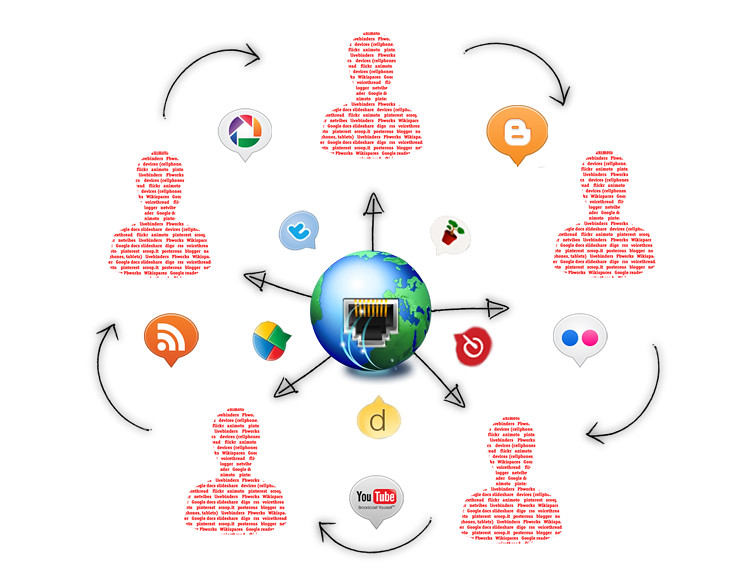
    The Social Wild Web in 2 Minutes and Teachers' Learning Brains

    I've produced this quick video as a Wrap up for the online course I am teaching, Web Tools for Educators at Casa Thomas Jefferson.


    In the beginning of our online session, teachers are generally in a state of lethargy and disorientation. They are never sure if they should endure in the digital experience or quit. They sometimes have a feeling of being overwhelmed, at other times, at loss... I try to show them that this a common state when we face the new, when we leave our comfort zones, when we are learning, when we are challenged.

    In neuroscience there's a common term to express the exact moment when our amygdala sense danger:
    FLIGHT - FIGHT - FREEZE
    We generally react in these three ways: we can just run away from the new experience as we feel threatened, we might decide to persist and move on against the initial moment of fear and helplessness, or we can just be in a lethargic state of no-action. 

    My role as an online facilitator is to give participants the support they need for them to build up their self-confidence and move forward, fighting against their initial disorienting feeling of the non-linear digital world. Isn't that what we all try to do with our students, anyway? In this case, though, it is an even more important mission, for if they see the power of the Social Web in transforming their classrooms and beyond in truly student-centered learning hubs where interaction, collaboration, problem solving, creative thinking, fun-based learning is part of class routine, then my special assignment as an online facilitator is accomplished, and the impact of teachers' newly acquired digital skills is long-lasting and amplified in their local educational communities. 

    That's why when they overcome the initial stage of getting their feet wet into learning how to participate in an online community, enhanced by numerous digital tools, they get into the experimentation level, evolving to many WOW moments throughout our 10-week online session and way beyond. 

    Of course, there are those who always fly, and those who get stuck, freezing, no matter what you try to do  to give them the support they need. Educators must first re-learn to unlearn. Educators must be open to learning if they want to be part of education. However, what really makes a difference is letting our brains work in our favor, when we fight against the initial fear and sense of being in danger, for endangered professionals are the ones who are not open to movement, change and action.

    by FabrĂ­cio Freire_WebTools4Educators

    The Social Web is full of encounters, learning and networking. And every educator should be part of it in very meaningful ways, and that's why it is part of my job to introduce the educators who start the Web Tools for Educators course to get there in the SOCIAL WILD WEB!