Showing posts with label ctj. Show all posts

Friday, July 26, 2013

TEFL Conference Series Part 1 - App Swap


The app swap we had in IATEFL 2013 in Liverpool with Joe Dale, Shaun Wilden, Ana Maria Menezes, among other educators make me consider repeating the model in our CTJ, Alumni and IBEU TEFL Conference in Brasilia.

The session in which participants were the lead presenters in break out groups were the stars of the session, sharing with others their favorite apps for the classroom or for personal use. Vinicius Lemos and I started by giving an example of tools and, from there, teachers never stopped sharing.

As they shared their favorite apps with the others, we kept walking around adding the names of the apps to our collaborative page on Todaysmeet.

Enjoy it. Try some them.

http://todaysmeet.com/appswapctj


You might be interested in the shared list of apps in IATEFL at http://list.ly/list/4NE-app-swap-iatefl-2013

Thursday, March 21, 2013

Taking Learning Into a Visual Experience Through Infographics


Evolving, progressing, developing. Not always an easy task, mainly for very busy English teachers who have heavy schedules, different groups with varied age range and levels of proficiency. But still, they are up to the challenge of after a long day of work to come to a Teacher Development Course to keep improving to become for full-fledged professionals.

That's the context I have with my also challenging job of working with these teachers to raise their level of understanding of Ed Tech issues and help them learn about practical Ed Tech ideas for their classrooms. Challenging not because of the educators I have in class. They are a fantastic, enthusiastic bunch. Daring because of the responsibility of having a full month for Educational Technology in the Methodology part of the TDC program. Until last semester we'd have only a 2-hour encounter with TDC students. So, two hours turned into a fascinating monthly opportunity to inspire, go above and beyond with those teachers.

Of course, it is no easy task for them. Besides the heavy duty of going through many different concepts, ideas and practicalities of integrating Ed Tech in the classroom, they still have to deal with the hybrid format of this part of the course (1 face-to-face class + 1 online class per week) and my pushing them to do more than just average. A bit of pressure, I know, but I'm totally in awe of what I've seen so far, particularly what I had the chance to contemplate, discuss and learn about last class.

I had assigned Mark Warschauer's text "Technological Change and the Future of CALL", part of an ESL & Applied Linguistics Professional Series, "New Perspectives on CALL for Second Language Classrooms", edited by Sandra Fotos and Charles Browne. Besides classroom discussion, I wanted to profit from the elearning environment and the new trends in Ed Tech to explore the possibilities of the use of infographics in the classroom. There was a bit of whining and moaning because of the complexity of the infographics platforms and technical issues that students faced, but the outcomes were simply way more than one could ever expect...
The student-teachers found their own ways to overcome the technical challenges, and the result was a class full of sharing, discussions and considerations about CALL history, its present state and what the future holds. The infographics were the springboard that inspired us all to learn and share. One of the students, a designer by heart and profession, was even applauded by the class when he entered the room with his infographics created in Illustrator that not only visually represented the text but also enticed the readers to consider our pedagogy in the 21st century in his humorous bottom part of the infographic:

by Gustavo Dias

And here's the collective effort of the group that makes me certain that, yes, even with some pain, there was an amazing learning gain that I am super proud of. I hope that these teachers understand the power of such an activity to take their own students to another learning level. Not that they will ask students to create an infographic, but what are some of the creative practices we can adopt to enhance learning in an EFL/ESL classroom and really give choice, purpose and audience to our students' production?

If you are just curious about the infographics platforms that I suggested, here they go:


visually 
easelly
   infogram
    piktochart

Just remember that if you want to try them out, do like my students: persist!

For some cool infographics >>> http://pinterest.com/ctjonline/infographics/

Wednesday, May 2, 2012

The Social Wild Web in 2 Minutes and Teachers' Learning Brains

I've produced this quick video as a Wrap up for the online course I am teaching, Web Tools for Educators at Casa Thomas Jefferson.


In the beginning of our online session, teachers are generally in a state of lethargy and disorientation. They are never sure if they should endure in the digital experience or quit. They sometimes have a feeling of being overwhelmed, at other times, at loss... I try to show them that this a common state when we face the new, when we leave our comfort zones, when we are learning, when we are challenged.

In neuroscience there's a common term to express the exact moment when our amygdala sense danger:
FLIGHT - FIGHT - FREEZE
We generally react in these three ways: we can just run away from the new experience as we feel threatened, we might decide to persist and move on against the initial moment of fear and helplessness, or we can just be in a lethargic state of no-action. 

My role as an online facilitator is to give participants the support they need for them to build up their self-confidence and move forward, fighting against their initial disorienting feeling of the non-linear digital world. Isn't that what we all try to do with our students, anyway? In this case, though, it is an even more important mission, for if they see the power of the Social Web in transforming their classrooms and beyond in truly student-centered learning hubs where interaction, collaboration, problem solving, creative thinking, fun-based learning is part of class routine, then my special assignment as an online facilitator is accomplished, and the impact of teachers' newly acquired digital skills is long-lasting and amplified in their local educational communities. 

That's why when they overcome the initial stage of getting their feet wet into learning how to participate in an online community, enhanced by numerous digital tools, they get into the experimentation level, evolving to many WOW moments throughout our 10-week online session and way beyond. 

Of course, there are those who always fly, and those who get stuck, freezing, no matter what you try to do  to give them the support they need. Educators must first re-learn to unlearn. Educators must be open to learning if they want to be part of education. However, what really makes a difference is letting our brains work in our favor, when we fight against the initial fear and sense of being in danger, for endangered professionals are the ones who are not open to movement, change and action.

by Fabrício Freire_WebTools4Educators

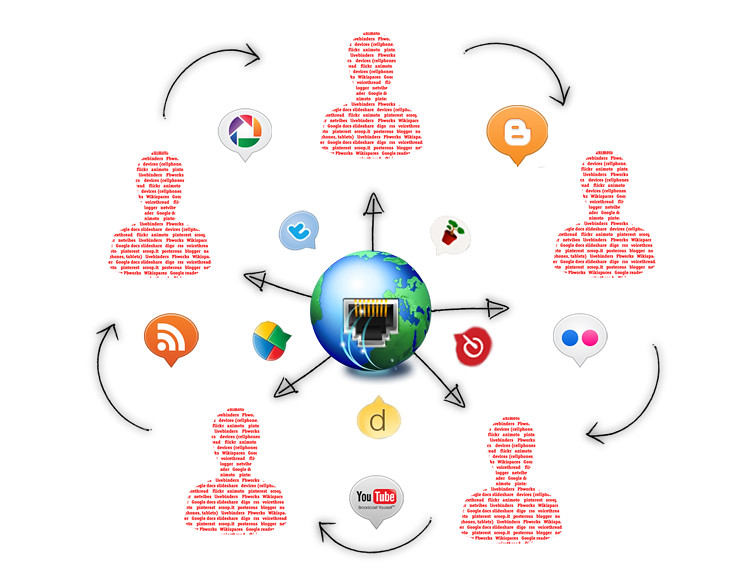
The Social Web is full of encounters, learning and networking. And every educator should be part of it in very meaningful ways, and that's why it is part of my job to introduce the educators who start the Web Tools for Educators course to get there in the SOCIAL WILD WEB!


Sunday, July 25, 2010

Language Teaching - Tools Worth Checking

Our presentation at the Braz-TESOL Conference and CTJ TEFL (Casa Thomas Jefferson - Brasília) went well with many teachers showing interest in the topic and wanting to make the change necessary to make the learning experience even more exciting.

Here's the slideshow for the presentation. Just click on the images and you'll be taken to the tools and their examples:


We also had the chance to present in the CTJ Electronic Village, a reduced, but highly effective version of TESOL's Electronic Village. The Ed Tech Team shared some resources and hands-on ideas for the language classroom.
http://ctjelectronicvillage.pbworks.com/2010


Still on the topic of effective tools for the classroom,I just came across this list compiled by the Nerdy Teacher, whom I highly recommend the following.

Related Resources:
http://brazilbridges.pbworks.com/Cool-Tools
http://collablogatorium.blogspot.com/search/label/cooltool

Tuesday, March 30, 2010

Our Drives

I´ve just started reading Daniel Pink´s latest book, now better than ever with the wonderful little gadget my dear friend Dennis Oliver gave me. During my 45-minute workout I can easily flip pages in my Kindle. Never has it been so pleasant to exercise in two such good companies, the book and my new digital toy! Gratitude apart, I have to say that Daniel Pink´s concepts resonates with what I think and what I see happening with people around me.

He mentions three of our main drives, the biological one - our first drive that made us survive as species, the externa rewards and punishments, our carrots and sticks, and our Third Drive, that intrinsic, transcendent motivation that makes us move beyond and do things out of the common sense.

One example of that is certainly the Ed Tech Team I work with at my school. These guys are just an incredible bunch. They don´t get any external reward, no extra money to do what they do, not the hours they deserve to work on the many projects we have. In fact, they have only 2 administrative hours to perform their roles, but they go way beyond. They spend sleepless nights, have brilliant ideas to tackle our educational issues, they are constan problem solvers, they are teachers supporters, help desk, imaginative, creative souls that have this drive, this intrinsic motivation to think and act, to support and share. Only by understanding the nature of this inner drive we have, we´re able to reach this group´s motivation to be there, only by getting the sense of flow, generosity, commitment, creativity, we get the feeling of what motivates us to step forward is certainly this heuristic tasks we perform that gives us personal self-fullfillment, self-directedness and the recognition of our work by our colleagues.

What would be other examples of drive that are not explained by external rewards and the fear of punishment: