Monday, October 28, 2013

The Image Conference Presentation - Transforming Sins into Virtues in Design for Learning


We had a great Friday event - The Image Conference, organized by the BRAZTESOL Brasilia team, with the support of the IATEFL Learning Technologies SIG and Kieran Donaghy, the one who started the Image Conference in Barcelona.

After such an intense day and weekend, I haven´t had time to put my thoughts together in a blog post with the ideas and resources I presented, but Graham Stanley, one of our keynote speakers and amazingly fast and efficient blogger did it all and saved me some precious hours!

You can read about the whole idea of the presentation at
http://blog-efl.blogspot.com.br/2013/10/carla-arena-transforming-sins-into.html

Graham is really amazing! And nobody can beat him when it gets to blogging! Thanks, my friend.


The Image Conference_Brasilia_October 2013 (86)

Saturday, October 12, 2013

How Much we Reach and Inspire Educators


I could be here mentioning the educators who have been inspiring me for the past decade, but it wouldn't be fair, as I might forget a name or an episode that transformed me...What I want to say is that since my first trip to a TESOL International Conference in San Antonio, Texas, in 2005, my professional life turned upside down through the many connections I made and the learning I had, picking up the brains from so many inspiring people around the globe. The kickstart, a group of International educators who are constantly connected through a Yahoogroups, called the Webheads. Of course, it goes way beyond the Yahoogroups. We are connected emotionally, we meet each other in conferences, we do collaborative projects together, we share our accomplishments and epic failures. In fact, we rely on the network to grow, to learn, to make sense...

The same way I feel about the Webheads, others experience this feeling of having discovered a whole new world, and what I do for the network is totally worth it when I hear someone say how I helped him/her move to the next level. We never know what are reach are with the ones surrounding us, our kids, our friends, students, teachers. We just know that through connections we are transformed.

So, it was with surprise and enjoyment that I read those words from Márcia, a dear friend, whom I saw grow and flourish in the digital arena,

"Carla is, as I call her, my PLN first love. It was a Sunday, 14 November, 2010, when my life started to change. And it was all Carla's "fault"! I came across Carla’s blog post on elearning speedgeeking and that led me to her twitter account (or was it the other way around?) The truth is, it was then that I fell in love with Carla, who was the first member of my adorable PLN and to whom I owe having become a more engaged and techy teacher. Like me, hundreds or, most problably, thousands of teachers worldwide have been inspired by this passionate dedicated professional, who found the power of technology as a connective and transformative tool in the classroom from her first days as a teacher. Nowadays, more than tech in class, she’s excited about the new possibilities of its way beyond the four walls. That's why for the past years she has, among other things, been an enthusiast Webhead and dedicated herself to the eLearning program at a Binational Center in Brazil, where she is the Educational Technology Supervisor, and to the TESOL EVO Coordinating Team."

I was touched by Márcia's word. I'd never have known that if it weren't for her written words and the EdInspire nomination she made. He words made me realize that, yes, we can make a difference in so many ways. So, let's do what we are meant to do to others. Let's be generous with our communities. Let's do our share. Let's change, let's make a revolution.

And, most of all, let's show appreciation to the ones who inspire us. I'm sure it will mean a lot to them, as it meant a lot to me what Márcia said.

Thanks, Márcia, for your kindness and generosity with me and with our network.

Wednesday, October 2, 2013

On the Ed Tech Radar - Free Online Professional Development Opportunities in October


Stay at the comfort of your home or keep yourself comfortable in your office, but don´t miss two great professional development opportunities that you can access from wherever you are in the world for free.

October 12th - TESOL CALL-IS & IATEFL LEARING TECHNOLOGIES SIG Online Conference

It starts at 2pm GMT / 3pm London time / 7am Pacific/ 11 am Brasilia time with fabulous guest speakers like Prof Carol Chapelle, Shaun Wilden, Gavin Dudeney, Nicky Hockly, Deborah Healey, Phil Hubbard, Sophie Ioannou-Georgiou, Paige Ware, Elizabeth Hanson-Smith, Christel Broady and a closing joint session at 8pm GMT / 9pm London / Pacific 1pm/ 5pm Brasilia Time.


From October 11 to October 13th - The Reform Symposium Online Conference


The 4th annual Reform Symposium Conference (RSCON), a free online three day event bringing together educators, students and innovators from around the world, will be held October 11th to 13th in conjunction with Connected Educator Month. 
The Reform Symposium Conference is a global community initiative to transform teaching and learning. The Reform Symposium Conference will be a highly inclusive and engaging event that will encourage students and educators around the world to share and learn about transformative approaches to learning and teaching. To attend this year's conference and to be kept informed of the latest conference news and updates, check http://www.futureofeducation.com/page/2013-reform-symposium. There will be

There are no excuses for you to invest in your professional growth, learn from educators around the globe and connect with a great audience!

Tuesday, October 1, 2013

Technology Giving Wide Wings to Creativity


As long as I keep seeing transformative and exciting examples of how technology can help the next generation of professionals acquire new skills in different areas, I'll advocate its use.

That's exactly what happened with me some days ago. I was at the Apple Store with my kids, looking for the present my husband had asked for his 40th birthday, his first Mac. In fact, his first computer! Up to that point he'd just use all the gadgets I would put aside or my kids' computers or mine. Anyway, I was there talking to the salesman while my kids had fun with an iPad Mini. They were giggling, whispering, having real fun. So much fun indeed that I thought that they were certainly playing a cool game.

To my surprise, when I closed the deal and invited them to eat something. They asked me to come closer, for they had something to show me. I had a blast! In just some minutes, all by themselves, they figured out how to use the app iMovie and were, in fact, enjoying themselves as movie producers. The result? Check for yourself how far kids' creativity can travel if they have the means and freedom to go beyond the regular, the ordinary:


I guess that this video is what I've been always trying to show teachers. Technology empowers, decentralizes learning in ways that we should really reconsider our roles as educators not because everyone else is telling us so, but because our kids, our students need guidance, expertise and wisdom to move forward and succeed now and beyond when they become professionals.

One thing they were having trouble doing? Transferring the video to youtube. I also showed them how important it was to delete the video from the public iPad Mini and from the app due to digital safety issues.

Learners' creativity harnessed by technology and guided by an educator's wisdom is certainly an explosive combination. That's why I'll make sure that I help more and more educators get there in their digital literacies. I'll make sure that I give them support to let their learners express themselves and fly even higher.

What have you been doing to encourage your students' creative juices to emerge?


Wednesday, September 11, 2013

Curation Talk at Universidade Católica de Brasília


I had a great time with the languages students at Universidade Católica de Brasilia.
Once again I had the pleasure to explore a topic that every educator, every learner should learn about in order to take the best of their networks and give it back, as well, curation.


Digital Curation for Educators from Carla Arena

For some other references that I blogged about, check http://collablogatorium.blogspot.com.br/search/label/curation

Joyce Valenza, a teacher librarian, has wonderful content curation resources available at http://joyce-valenza.wikispaces.com/Content+Curation

And here´s a comparison page of curatorial platforms with tons of sites to explore http://socialcompare.com/en/comparison/curation-platforms-amplify-knowledge-plaza-storify


Monday, September 9, 2013

On the mLearning Radar - Creating on iPads


I´ve just come across this box of mlearning treasures that an art teacher/teacher trainer has put together. Though the focus is on digital art, many ideas can be adapted for the language classroom.

http://drydenart.weebly.com/creating-on-ipads.html
Mrs. Fuglestad has also created a Smore page with ideas for ipad creation. What I think could be the main focus for language teachers is to consider the mobile devices students have to work on language production and creation, just like in an art class.

https://www.smore.com/r98j-summer-ipad-lesson-ideas


Can you think of any idea to remix an idea Mrs. Fuglestad presented to fit a lesson plan you will be teaching in the near future?


Friday, September 6, 2013

On the Ed Tech Radar - A Collection of Digital Posters Platforms for Educators

I have been part of an exciting teacher training program in the state of Rio and this week I´m exploring with teachers the possibilities of Digital Posters in the classroom. I´ve created this Padlet with some digital posters platforms that let teachers and students create wonderful digital artifacts. I thought educators might profit from it:

How do you envision using those posters in your classroom?

Thursday, September 5, 2013

Teaching a Dramatically Outstanding Class - Tension and Release


Yesterday I was talking to a very experienced teacher who I know suffers from the same syndrome I do and most of the teachers out there do. The how-can-I-reach-teens syndrome.

We all develop strategies, sometimes war strategies, we think and re-think ways that we could better engage our teens. The roller coaster is always on and the list of our trials and errors abounds:

- using tech in class
- making them move
- using topics that are close to their hearts
- songs
- giving some free time if they "behave"
- using games

And the list goes on. Some activities seem to work better than others. And my guess is that generally what ticks our teens are not exactly those sophisticated types of lessons that we spent hours preparing. Sometimes they surprise us by enjoying a very simple task you propose. Have you every considered the main elements of these moments of engagement are made of?


2010 Teen Arts Fusion | Graphic Novels

My insight tells me that no matter what we do, what makes an activity engaging is not the degree of sophistication or the main topics that will reach our learners or even the many hours you took to prepare it. Just today I read an interesting article that gave me a hint of what might make a class dramatically outstanding in which you feel that sense of flow and you know the students are there with you in the same wavelength. As stated in Wikipedia, you and your students turn into
"mental state of operation in which a person performing an activity is fully immersed in a feeling of energized focus, full involvement, and enjoyment in the process of the activity. In essence, flow is characterized by complete absorption in what one does."
How?

By unconsciously using the idea of "Tension and Release", by creating a moment in which you reach a climax of your class with an activity that the students feel compelled to participate, to "solve the puzzle", to be part of it. That's why storytelling is so powerful. It is just one of the many shapes you can build upon the idea of "tension and release" to create engagement.

Let's consider, for example, TV shows, series, Brazilian soap operas, films...What do they do to keep us there on the edge of our seats?! Tension and release! That moment before the disclosure where our heads spin, then the relief of seeing everything unfolding.

When was the last time you had this "tension and release" moment in your class? What made it special? What was your trick?

If we teachers can spot these aha "tension and release" moments in our classes, our how-can-I-reach-teens syndrome might be overcome.

Tuesday, September 3, 2013

Making Homework Assignments Smarter for your Students and their Brains


One of my favorite bloggers, Annie Murphie Paul, has written a post about homework that every educator should consider as a guideline for better learning opportunities. Her claim, based on Neuroscience and Psychology research, entails making better use of strategies that are effectively proven to have an impact on learning.

Annie mentions three strategies that could be used by educators when they are considering the kind of extra-class activities they will assign:

- Spaced Repetition - instead of assigning units of content and then "getting over" them and moving to the next topic, make sure you come back to the content students have explored last week or in the past month over and over in different ways.

As the blogger puts it,
"Exposing ourselves to information repeatedly over time fixes it more permanently in our minds, by strengthening the representation of the information that is embedded in our neural networks."

- Retrieval Practice - In the beginning of the year, I explored the topic in a post about "learning by retrieval", which evokes the power of using testing/assessment tools more often to constantly retrieve information in a more active processing of the brain, instead of just studying content or taking notes. By working on the output of the language, learners are able to strengthen the brain connections for the content they are learning. This requires more of a study-test-study-test-study-test perspective rather than just study-study-study-test approach that we generally have. And by testing, we're not talking just about standardized tests, but self-assessments, quizzes, every kind of assessment that challenges the mind and retrieves information over and over again.

- Interleaving - Consider our homework assignments. Make an auditing of what you've asked your students to do in the past month. I bet that we have generally asked them to focus on the content they're studying right now in class and with types of problems and situations that are similar to each other to "make sense" for the students. In fact, what Annie Paul suggests based on recent studies and even sports training is that we mix up the types of problems and situations students will have to deal with for homework in a way that the sequence is not really predictable. By doing that, we force the brain to "work harder" to try to figure out the solution.

I think that the best chance we have to reconsider our homework practices is to audit what we've been doing and strategically plan ahead. Here's an initial list that might help:

- Have I used any of those three strategies - spaces repetition, retrieval practice, interleaving - in any of my past month assignments? If so, how?
- Have I varied the types of homework I assign to students or do they all follow a regular pattern?
- How challenging and motivating those homework assignments seem to be to my students? Have I ever asked them which types do they prefer, which are more challenging and which they feel are more effective for them in retrieving what they've learned?

Thinking strategically:

- How can I make homework assignments a more meaningful part of my teaching?
- How can I intertwine those 3 strategies to compare learning results?
- How can I check the effectiveness of the new strategies I try to use?
- How can I make homework a more challenging and engaging part of my classes?

I'd love to hear your views and findings about homework in the classroom and how they can be transformed to make it a relevant learning tool for our students.

Monday, September 2, 2013

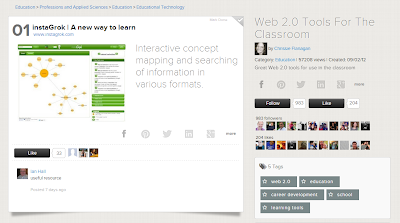
On the Ed Tech Radar - A Learnist Web2.0 Resource for Educators


I´ve already mentioned Learnist as an interesting learning playlist tool that can be used by educators and learners.

This Learnist is one educators will love, with all kinds of digital resources in one single place.

http://learni.st/users/bryanNchrissie/boards/4090-web-2-0-tools-for-the-classroom