I have been part of an exciting teacher training program in the state of Rio and this week I´m exploring with teachers the possibilities of Digital Posters in the classroom. I´ve created this Padlet with some digital posters platforms that let teachers and students create wonderful digital artifacts.
I thought educators might profit from it:
How do you envision using those posters in your classroom?

An exploratory journey of an educator who thrives for meaningful conversations. Lifelong Learning, Education, Ed Tech, Change.
Friday, September 6, 2013


Thursday, September 5, 2013
Teaching a Dramatically Outstanding Class - Tension and Release
Yesterday I was talking to a very experienced teacher who I know suffers from the same syndrome I do and most of the teachers out there do. The how-can-I-reach-teens syndrome.
We all develop strategies, sometimes war strategies, we think and re-think ways that we could better engage our teens. The roller coaster is always on and the list of our trials and errors abounds:
- using tech in class
- making them move
- using topics that are close to their hearts
- songs
- giving some free time if they "behave"
- using games
And the list goes on. Some activities seem to work better than others. And my guess is that generally what ticks our teens are not exactly those sophisticated types of lessons that we spent hours preparing. Sometimes they surprise us by enjoying a very simple task you propose. Have you every considered the main elements of these moments of engagement are made of?

"mental state of operation in which a person performing an activity is fully immersed in a feeling of energized focus, full involvement, and enjoyment in the process of the activity. In essence, flow is characterized by complete absorption in what one does."How?
By unconsciously using the idea of "Tension and Release", by creating a moment in which you reach a climax of your class with an activity that the students feel compelled to participate, to "solve the puzzle", to be part of it. That's why storytelling is so powerful. It is just one of the many shapes you can build upon the idea of "tension and release" to create engagement.
Let's consider, for example, TV shows, series, Brazilian soap operas, films...What do they do to keep us there on the edge of our seats?! Tension and release! That moment before the disclosure where our heads spin, then the relief of seeing everything unfolding.
When was the last time you had this "tension and release" moment in your class? What made it special? What was your trick?
If we teachers can spot these aha "tension and release" moments in our classes, our how-can-I-reach-teens syndrome might be overcome.
Tuesday, September 3, 2013
Making Homework Assignments Smarter for your Students and their Brains
One of my favorite bloggers, Annie Murphie Paul, has written a post about homework that every educator should consider as a guideline for better learning opportunities. Her claim, based on Neuroscience and Psychology research, entails making better use of strategies that are effectively proven to have an impact on learning.
- Spaced Repetition - instead of assigning units of content and then "getting over" them and moving to the next topic, make sure you come back to the content students have explored last week or in the past month over and over in different ways.
As the blogger puts it,
"Exposing ourselves to information repeatedly over time fixes it more permanently in our minds, by strengthening the representation of the information that is embedded in our neural networks."
- Retrieval Practice - In the beginning of the year, I explored the topic in a post about "learning by retrieval", which evokes the power of using testing/assessment tools more often to constantly retrieve information in a more active processing of the brain, instead of just studying content or taking notes. By working on the output of the language, learners are able to strengthen the brain connections for the content they are learning. This requires more of a study-test-study-test-study-test perspective rather than just study-study-study-test approach that we generally have. And by testing, we're not talking just about standardized tests, but self-assessments, quizzes, every kind of assessment that challenges the mind and retrieves information over and over again.
- Interleaving - Consider our homework assignments. Make an auditing of what you've asked your students to do in the past month. I bet that we have generally asked them to focus on the content they're studying right now in class and with types of problems and situations that are similar to each other to "make sense" for the students. In fact, what Annie Paul suggests based on recent studies and even sports training is that we mix up the types of problems and situations students will have to deal with for homework in a way that the sequence is not really predictable. By doing that, we force the brain to "work harder" to try to figure out the solution.
I think that the best chance we have to reconsider our homework practices is to audit what we've been doing and strategically plan ahead. Here's an initial list that might help:
- Have I used any of those three strategies - spaces repetition, retrieval practice, interleaving - in any of my past month assignments? If so, how?
- Have I varied the types of homework I assign to students or do they all follow a regular pattern?
- How challenging and motivating those homework assignments seem to be to my students? Have I ever asked them which types do they prefer, which are more challenging and which they feel are more effective for them in retrieving what they've learned?
Thinking strategically:
- How can I make homework assignments a more meaningful part of my teaching?
- How can I intertwine those 3 strategies to compare learning results?
- How can I check the effectiveness of the new strategies I try to use?
- How can I make homework a more challenging and engaging part of my classes?
I'd love to hear your views and findings about homework in the classroom and how they can be transformed to make it a relevant learning tool for our students.
Monday, September 2, 2013
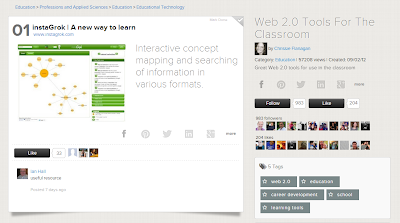
On the Ed Tech Radar - A Learnist Web2.0 Resource for Educators
I´ve already mentioned Learnist as an interesting learning playlist tool that can be used by educators and learners.
This Learnist is one educators will love, with all kinds of digital resources in one single place.
 |
| http://learni.st/users/bryanNchrissie/boards/4090-web-2-0-tools-for-the-classroom |
Saturday, August 31, 2013
The Magic of Professional Development Claims for a Growth Mindset
For years I've been training teachers and coaching them to integrate technology into the classroom.
The changes I've seen around throughout those years vary from none to new, reinvigorated professionals. How does the move happen?
Change will take many different shapes, from reframing an activity the teacher has already tried out to taking the leap into the unknown and thinking of the transformative power of new technologies in the classroom.
The pace is also varied. Some just jump in, others need a "marinading" period to let things sink in and make sense of what's going on.

However, transformation has its commonalities from what I've noticed. Educators who embrace change:
- are optimists by heart (even when they seem wary of new situations, deep down there they believe change can be good)
- believe in their own power to change direction, even if they feel insecure at first
- are not considering if the professional development opportunities are paid hours or not (though we shouldn't be working for free, educators with an innovator mindset know that these hours will be paid back in other forms in the future)
- do not count their efforts in time spent, but how their effort transformed their practices
- do not give the same old excuse of lack of time; even in some minutes they can learn something new and apply to their classes
- like the adrenaline rush that comes with new findings
- still believe in the transformative power of education
- enjoy being in class with their students
- have, above all, a growth mindset.
And here's a passage from HBR Blog Network that gives a quick overview of a growth mindset as opposed to a fixed one:
"In her 2006 book, Mindset: The New Psychology of Success, Stanford Professor Carol Dweck distinguishes two extremes of the mindsets people tend to have about their basic qualities:
- In a fixed mindset, "your qualities are carved in stone." Whatever skills, talents, and capabilities you have are predetermined and finite. Whatever you lack, you will continue to lack. This fixed mindset applies not just to your own qualities, but to the qualities of others.
- In a growth mindset, "your basic qualities are things you can cultivate through your efforts...everyone can change and grow through application and experience." Qualities like intelligence are a starting point, but success comes as a result of effort, learning, and persistence."
There's certainly no formula to change and I might be a little too simplistic about what I see happening to the educators who take a leap of faith and move on, but in all these years the main traits I see in the ones who transform their classes and themselves are those of optimism, passion, eagerness to learn and attunement to their learners' worlds.
Do you fit in this category of educator who embrace professional development and change as part of your job? Or is it time to rethink what you are doing and how you face things?
If you are interested in the topic of change, you might enjoy reading Becky Bair's post "Changing Our ‘Stuff’ Is Not Enough"
Tuesday, August 20, 2013
Plano de Aula - A Sala de Aula e a Vaca Roxa
Poucas vezes faço concessões ao meu estilo de blogar e até mesmo a língua em que blogo. Por causa da minha linha professora-de-inglês-que-faz-parte-de-uma-comunidade, acabei sempre deixando de lado a minha tão querida língua materna pela a minha escolhida profissionalmente.
Hoje concedo e retribuo toda a generosidade da minha rede de professores brasileiros em escolas regulares, privadas ou públicas, para deixar aqui o apelo da "Vaca Roxa"!
Adoraria saber qual foi o seu momento "Vaca Roxa" nesse seu último mês em sala de aula.
Sunday, August 11, 2013
Introductions Practice in the EFL Classroom with Authentic Content
Besides using Haiku Deck app to create visually-appealing presentations, what if you used it with students to help them use language with content produced by real people. So, it is the old "this is..; she does this and that" with a twist in authenticity.
Take, for example, this presentation:
Created with Haiku Deck, the free presentation app for iPad
- The teacher could ask students to present her in the form of a paragraph with the most important information.
- Students can prepare questions based on the information presented, and then another students would act out as if she were the lady.
- Students could work on expanding the information on a slide as if they were the woman, i.e., they could talk about her 3 sons and husband (slide 2)
I'm sure you'll find wonderful "about me" presentations to work with language authentically in Haiku Deck's Pinterest Board:

Of course, it would be great if students could use one of the sample presentations to prepare their own "about me" page.
Saturday, August 10, 2013
Digital Curation for Business English Teachers - IATEFL BESIG
Last Sunday, Aug 4th, I had a great time interacting with Business English teachers all over the world in BESIG-IATEFL very well-organized online events.
Here are the slides:
We mainly explored http://cowbird.com for engaging personal stories related to the workplace, business world.
We talked about ways of using Pinterest for Business English classes by encouraging teachers to create topic board for students and inviting them on a Web Safari. Also, it would be wonderful if students created their own boards and shared with other students. The comment area in Pinterest has great potential for emergent conversations among a group. The teacher can also decide for one group collaborative board by inviting students to the topic board. It is just a fantastic collaborative approach to learning where you give choice, control and agency in the hands of students.
I was surprised to realize that not many teachers knew about http://getpocket.com , a place where you can add all the posts, articles, resources that you find online and want to keep "in your pocket" for later use. It is just very helpful to curate great content. From there, you can share resources with students and even encourage them to keep their "pockets"and share resources with the group. What I love about it is that it is totally crossplatform, with easy access on the web and any mobile device. Plus, to add resources to Pocket, you can install firefox and Chrome plugins to save them on the go.
Talking about cross platform, one tool that I feel has great potential for Business English teachers is http://newsmix.me . There you can create magazines with different topic feeds. It might help with authentic resources for students. Again, it is web-based as well as mobile device accessible.
Then, we moved on to learning playlists. Again, great potential for the classroom with platforms such as http://mentormob.com, http://learn.ist and http://theemefy.com . All worth the exploration with this great concept of giving more control for the students in their learning process.
Any other curatorial tools you'd add for the Business English Teacher?
Friday, July 26, 2013
TEFL Conference Series Part 1 - App Swap
The app swap we had in IATEFL 2013 in Liverpool with Joe Dale, Shaun Wilden, Ana Maria Menezes, among other educators make me consider repeating the model in our CTJ, Alumni and IBEU TEFL Conference in Brasilia.
The session in which participants were the lead presenters in break out groups were the stars of the session, sharing with others their favorite apps for the classroom or for personal use. Vinicius Lemos and I started by giving an example of tools and, from there, teachers never stopped sharing.
As they shared their favorite apps with the others, we kept walking around adding the names of the apps to our collaborative page on Todaysmeet.
Enjoy it. Try some them.
http://todaysmeet.com/appswapctj
You might be interested in the shared list of apps in IATEFL at http://list.ly/list/4NE-app-swap-iatefl-2013
Thursday, July 4, 2013
About Me - Creating a Digital Profile to Stand Out
I tirelessly mention in teacher training sessions the importance of establishing a reliable digital footprint. Of course, this involves many fronts, such as the kinds of photos you publish online, how you interact with online users, the resources you share, how generous you are in the network, among others.
However, one area that sometimes is overseen, though totally relevant, is our online profiles. We establish trust if we show ourselves through a nice image, what we say and show about ourselves. This means taking good care of social media profiles. Also, it is important to have an about you page that makes justice to who you are.
There are some very effective and cool platforms that you can use for this purpose, and here are some examples of my own digital profiles:

http://about.me/carlaarena
https://www.smore.com/qa7m-carla-arena
One, though, that I've just tried out and it has a really neat, visual presentation is Visify. I came across after seeing a tweet by Jesse Stommel. Check the final result of my profile, which took less than 10 minutes to have this outcome:

https://www.vizify.com/carla-arena
What's your favorite profile page on the Web?
Can you imagine how exciting it would be to use those profiles, real ones, for authentic language practice in the classroom?
One idea would be to ask someone you know to create one of those, use it in class, and ask students to come up with followup questions. Then, the person could answer them in a video post, for example. How exciting would that be?!
Subscribe to:
Posts (Atom)